Last updated in August 2026
Quick Answer
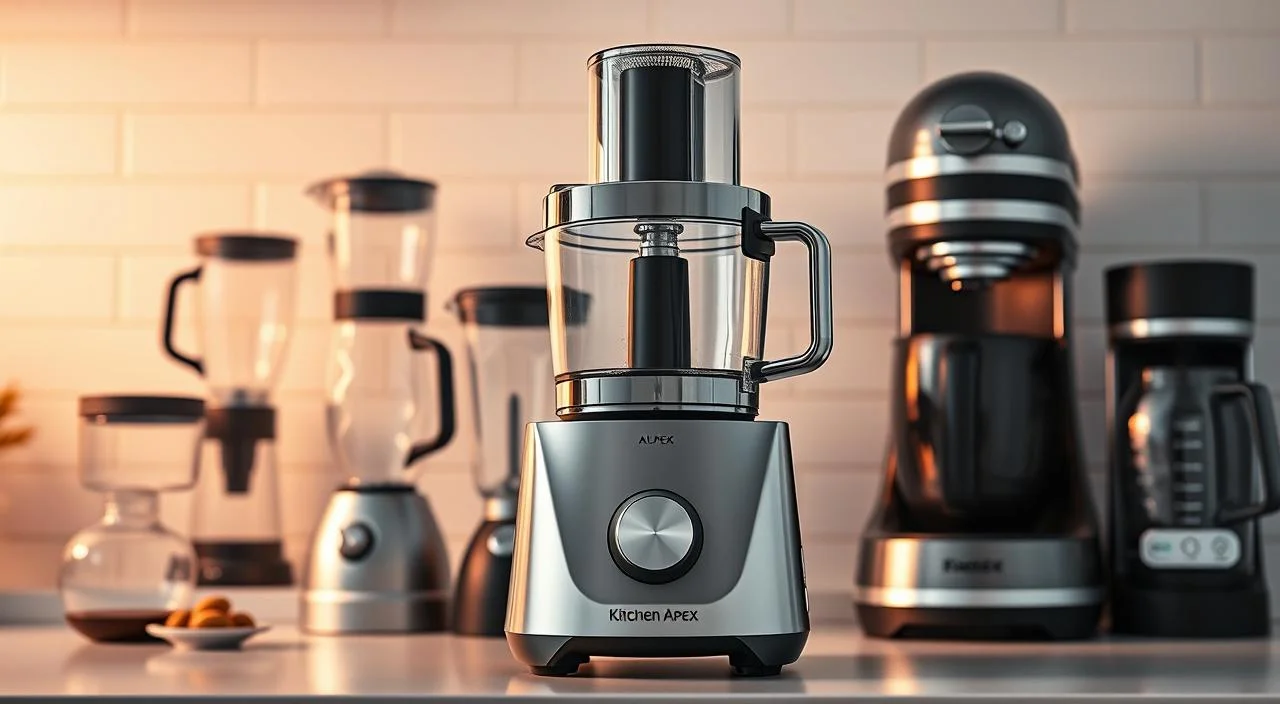
A food processor is a motorized appliance that uses rotating blades and discs to chop, slice, shred, puree, and knead food in bulk.
They save time during meal prep—especially vegetable work. The right one depends less on brand prestige and more on whether its size, power, and noise level match your actual cooking habits.
What Actually Happens Inside a Food Processor?
Food processors work by spinning sharp blades at high speed inside a sealed bowl. The motion repeats thousands of times per minute.
Each pass brings food into contact with the blade. Larger particles break down into smaller ones. With time, they become uniform in size or completely smooth.
This is different from hand chopping. Hand chopping is selective—you control each cut. A food processor is continuous—it processes everything equally until you stop it.
This makes it great for large batches. It also means you need to watch the texture; over-processing can turn vegetables into mush.
Why Size of Blade Matters
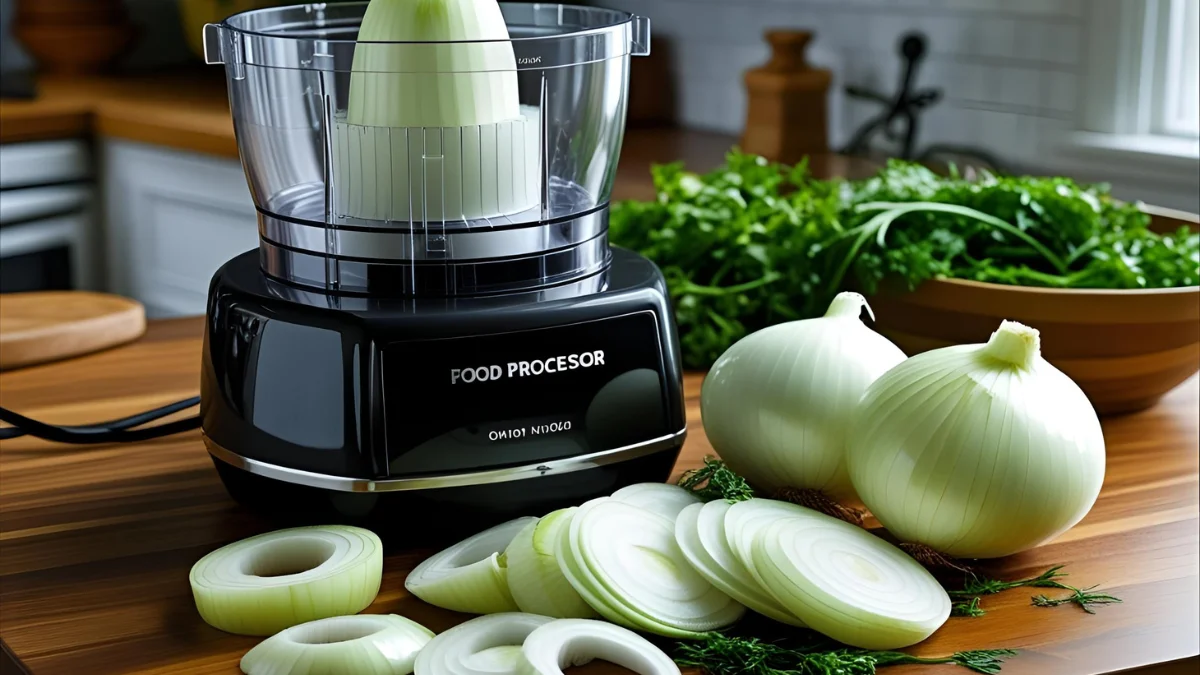
Most food processors have two primary blade types: the S-blade (metal, looks like an “S,” best for chopping and pureeing) and the slicing/shredding disc (replaceable discs with straight or serrated edges). Some smaller models include only the S-blade. Larger machines let you swap discs mid-task.
The S-blade is what makes most of the work happen. Its speed and sharpness determine how quickly food breaks down. A dull blade in a low-power motor will struggle with firm vegetables. A sharp blade in a high-power motor will over-process soft items if you’re not watching.
Motor Power: What the Wattage Actually Means
Food processor motors range from 150W to 1500W. Many buyers think higher wattage always equals better.
It doesn’t.
What wattage really measures:
Electrical energy input, not cutting speed. A 1500W motor delivers higher torque and sustained force, allowing it to chop dense foods (root vegetables, nuts, frozen items) without stalling. A 150W motor handles soft ingredients easily, but it will strain—producing a high-pitched whine—if pushed beyond its limit.
The trade-off:
Higher power usually means a larger motor base, a heavier footprint, and higher overall noise. A 1500W system might take more time to pull out, assemble, and clean than the prep time it actually saves for a quick meal. A compact 150W chopper won’t handle tough jobs, but it tucks away into a drawer in seconds.
Real Scenario Examples
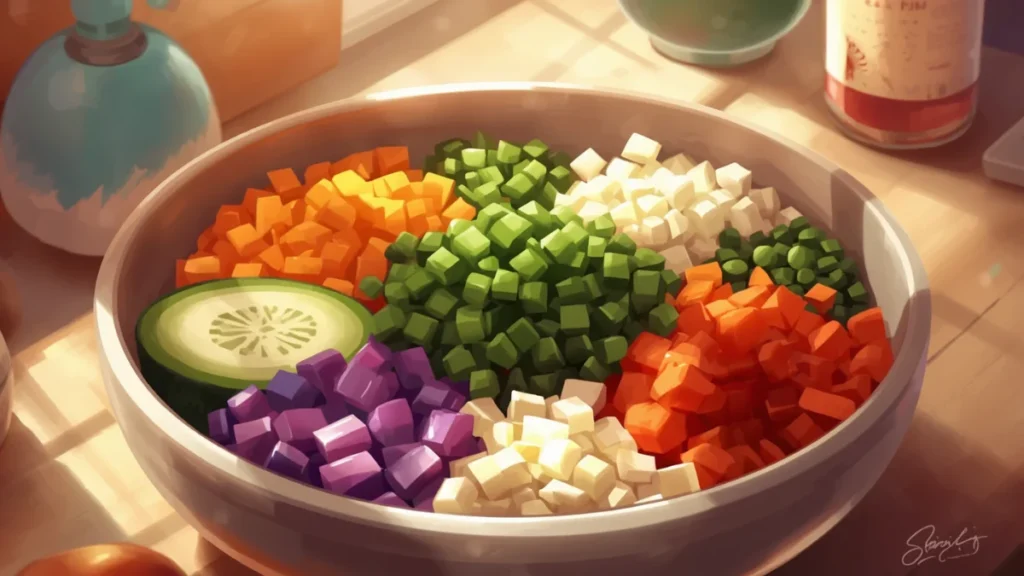
- Soft vegetables, herbs, bread, cooked food: 150–350W is sufficient. The motor isn’t the bottleneck; sharpness and bowl shape are.
- Firm raw vegetables, nuts, seeds, cheese: 350–750W gives consistent results without overworking.
- Frozen items, very hard foods, dough kneading: 1000W+ is worth considering. At this level, power actually prevents the motor from straining.
Capacity: Smaller Isn’t Always Bad (But It Means Batching)
Food processor bowls range from 1.5 cups to 14+ cups. Capacity directly affects how much you can process without emptying, refilling, and running again.
How to Think About Capacity
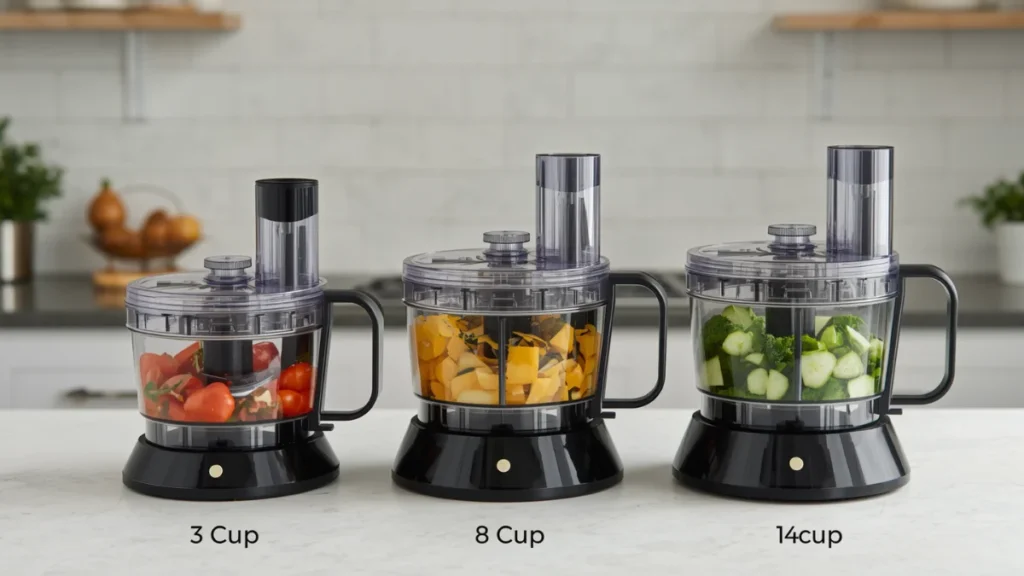
A 3.5-cup bowl works well for:
- Chopping one onion, one garlic clove, and herbs for a single meal.
- Making salsa or pesto for 2–4 servings.
- Grinding a handful of nuts or seeds.
A 14-cup bowl works well for:
- Chopping a full bag of vegetables for a week’s meal prep.
- Making large batches of dough or nut butter.
- Processing multiple ingredients in one session without stopping.
The honest trade-off: Smaller bowls are quieter, compact, and fast to clean. But if you batch-chop every Sunday, you’ll run the same 3-cup processor five times. A larger bowl means fewer batches—but it occupies permanent counter or cabinet space.
Storage Reality Check
A 14-cup Cuisinart-style processor is roughly 9 inches wide, 8 inches deep, and 12 inches tall. If you have tight cabinet space or a small kitchen, it won’t fit comfortably. Smaller choppers (3–4 cups) can tuck under a shelf or into a cupboard corner. This matters more than most articles admit.
The Attachment Question: More Isn’t Always Better
Many food processors come with multiple attachments: an S-blade, a slicing disc, a shredding disc, a dough hook, and sometimes a citrus juicer or grater. Manufacturers advertise this as versatility.
In practice, most users regularly use the S-blade and one disc (usually for slicing). The others collect dust.
Attachments add complexity:
- Storage. You need a place for each disc.
- Learning. Each disc does one job. You need to know which one.
- Cleaning. More pieces mean more washing.
A simpler processor with three core tools (S-blade, slicer, shredder) often outperforms a machine with eight attachments that confuse the user.
Noise and Speed: The Hidden Trade-Off
Food processors are loud. Most run at 70–85 decibels—roughly the volume of a busy restaurant. Higher-power models are louder. Compact, budget models are sometimes the loudest (straining harder with less power).
There’s no “quiet” food processor. If noise matters to you (early morning cook, apartment kitchen, sensitive ears), expect to run it during busier hours. Running the machine once for 30 seconds to chop an onion is noisier and more annoying than hand-chopping it.
Running it for two minutes to chop a full bag of vegetables? That’s where the appliance justifies the noise.
Durability: What Actually Lasts
Food processor lifespans depend less on brand name and more on:
- Blade and disc sharpness: Over time, even stainless steel dulls. Some manufacturers offer replacement blade packs. Check before buying if this matters to you.
- Motor quality: A well-designed motor runs cooler and lasts longer. Budget brands sometimes use cheaper motors that overheat. Brands like Cuisinart and KitchenAid tend to invest in this area.
- Seal and gasket materials: The rubber rings that keep food from leaking deteriorate after years of use and dishwasher cycles. Some models have replaceable seals; others require disposal of the entire bowl.
- Plastic vs. stainless steel body: Plastic bowls are lighter and quieter but scratch and can stain. Stainless steel is more durable but heavier and can dent.
Realistic lifespan: A well-maintained food processor lasts 5–10 years with regular use. If you process food twice weekly, expect the lower end. If you use it monthly, aim for the higher end.
Ease of Cleaning: Don’t Underestimate This
Food processor bowls, blades, and discs require hand-washing or dishwasher cycles. Some models have removable discs and interchangeable blades—easier to clean. Others have fixed attachments—trapped food particles are common.
Check before buying:
- Are discs removable? (Yes is easier.)
- Is the bowl shape simple, or are there corners where food hides? (Simple is better.)
- Does the manual mention dishwasher safety, or does it recommend hand-washing only? (Dishwasher-safe saves time.)
Sticky foods (nut butters, dough, fruit puree) require immediate rinsing. If you let a food processor sit with residue inside, dried-on particles are harder to remove and can harbor bacteria.
Real-World Models and What They’re Actually Good For
Rather than ranking them as “best,” here’s where each type excels:
Mini Choppers (1.5–3.5 cups, 150–350W)
Examples: Hamilton Beach 3-cup, KitchenAid KFC3516ER, Black+Decker 1.5-cup.
Best for: Singles, couples, small households, or as a second appliance.
Why: Fast, compact, minimal noise, easy cleanup. No buyer’s remorse if you don’t use it daily.
Reality check: Batch processing is required for large meals. Not ideal if you meal-prep five days ‘ worth of vegetables in one session.
Mid-Size Processors (4–8 cups, 400–600W)
Examples: Ninja Mega System, some Cuisinart compact models.
Best for: Families of 3–4, frequent meal preppers, those who need versatility without maximum footprint.
Why: Handles most vegetables in one or two batches. Quiet enough for regular use. Takes reasonable cabinet space.
Reality check: Still requires storage planning. More powerful than needed for soft items.
Full-Size Processors (11–14+ cups, 600–1000W+)
Examples: Cuisinart DFP-14BCNY, high-end Magimix or Robot Coupe.
Best for: Larger families, professional cooks, meal-prep enthusiasts, dough makers.
Why: True one-batch processing for weekly vegetable prep. Kneads dough reliably. Handles hard items without strain.
Reality check: Permanent counter or cabinet fixture. Overkill if you process food twice per month. Loud, even by food processor standards.
How to Avoid Over-Buying or Under-Buying
Ask yourself these questions honestly:
- How often will I actually use this? (Weekly or more = invest in power/capacity. Monthly or less = stay compact.)
- What’s my biggest prep bottleneck? (Vegetable chopping? Nut grinding? Dough kneading? Different tools excel at different tasks.)
- Do I have dedicated storage space, or will it live on my counter? (Permanent counter placement justifies size; temporary placement argues for compact.)
- Am I a “one big prep session” person or a “daily small tasks” person? (Weekly prep = larger bowl. Daily cooking = smaller, faster machine.)
- How sensitive am I to noise and cleanup time? (Both scale with power; acknowledge this trade-off upfront.)
If you’re unsure, start compact. A 3–4 cup mini processor costs $30–70. Upgrading to a full-size processor later is easier than realizing you bought a permanent countertop fixture you barely use.
Key Takeaways
- Food processors aren’t one-size-fits-all. Capacity, power, and noise level matter more than brand prestige.
- Motor power (wattage) matters for hard ingredients. For soft vegetables and herbs, the sharpness of the blade matters more.
- Smaller bowls (3–5 cups) are practical for small households but require batching. Larger bowls (11–14 cups) eliminate batching but demand counter space.
- Attachments beyond S-blade and slicing/shredding discs are rarely used. Simpler machines are easier to master.
- Food processors are loud. This is not a bug; it’s part of the design. Manage expectations on timing and location.
- Real lifespan depends on maintenance and frequency of use, not brand alone. Budget for blade sharpening or replacement in 5–7 years.
- If you’re between sizes, start with the smaller one. An inexpensive compact processor is easier to live with than a full-size one gathering dust.
Common Questions About Food Processors
Can I use a food processor to make smoothies or nut butter?
Not reliably. Smoothies require a high-speed blender (designed for liquids). Nut butter requires sustained grinding and friction (food processors can do this, but dedicated nut-butter makers are more efficient). A food processor is a chopper and mixer, not a blender.
How often should I sharpen or replace the blade?
Stainless steel blades dull gradually over the years. Most home cooks never sharpen them. When your machine stops processing quickly, it’s time to replace. Some brands sell blade kits for $15–30.
Is it normal for my food processor to leak?
No. Leaking usually means the rubber gasket (seal) is damaged or installed incorrectly. Check that the bowl is fully seated in the base and that the gasket isn’t twisted. If the leak persists, the gasket needs to be replaced.
Should I buy a full-size processor if I might cook more in the future?
No. “Might” is dangerous reasoning. Storage and noise regret are real. If your cooking needs change, upgrade then. Reselling a used compact processor is easier than rehoming a full-size one.
What’s the difference between a food processor and a food chopper?
Choppers are compact, simple machines (usually 150–400W, 1–3 cups). Processors are larger, more powerful (400W+, 4+ cups), with multiple blade options. Choppers are for quick single-task jobs. Processors are for batch work and versatility.
Can I use a food processor to chop hot food right after cooking?
Yes, but let it cool to warm (not steaming) first. Steam inside the sealed bowl can be unpleasant. Also, hot food is mushier and processes faster, so watch the texture closely.
How do I prevent over-processing (mushy texture)?
Pulse the machine (press the button, release, repeat) instead of running continuously. This gives you control. Most food processors have a pulse button exactly for this reason.
Recommended Reading
- Instant Pot Pressure Cooking Times Chart: Common Foods + Conversions
- Best Coffee Makers with Grinder Built-In (2026): Fresh-Ground Coffee Made Simple
- Moka Pot vs AeroPress vs French Press: Which Brews Best Coffee? (2026)
- Best Oils for Air Fryer Cooking (Smoke Points Explained)
- Best Air Fryer for Large Families (2026): 5+ Quart Capacity Tested
- How to Make Nut Butter in a Blender (Without Overheating)
This guide is focused on educational clarity, not product rankings. The goal is to help you make a decision that matches your actual cooking habits, not to convince you to buy the biggest or most expensive model. Food processors are valuable kitchen tools when chosen thoughtfully. Choose wrong, and you’ll end up with a noisy countertop fixture. Choose right, and you’ll save real time on your most tedious prep work.