Category: Kitchen Appliances · Dehydrators | Reading time ≈ 7 min | Last updated: September 2026 | Prices re-verified at time of writing
We did not run 20+ batch cycles. Every spec below is drawn from manufacturer documentation and verified live listings — see the research method declaration.
Store-bought beef jerky runs roughly $7–$12 per ounce. Homemade jerky, once you own a dehydrator, lands closer to $1–$2 per ounce — and you control the sodium, sugar, and additives. For anyone who makes jerky or dried fruit regularly, a dehydrator can pay for itself within roughly 6–12 months of steady use.
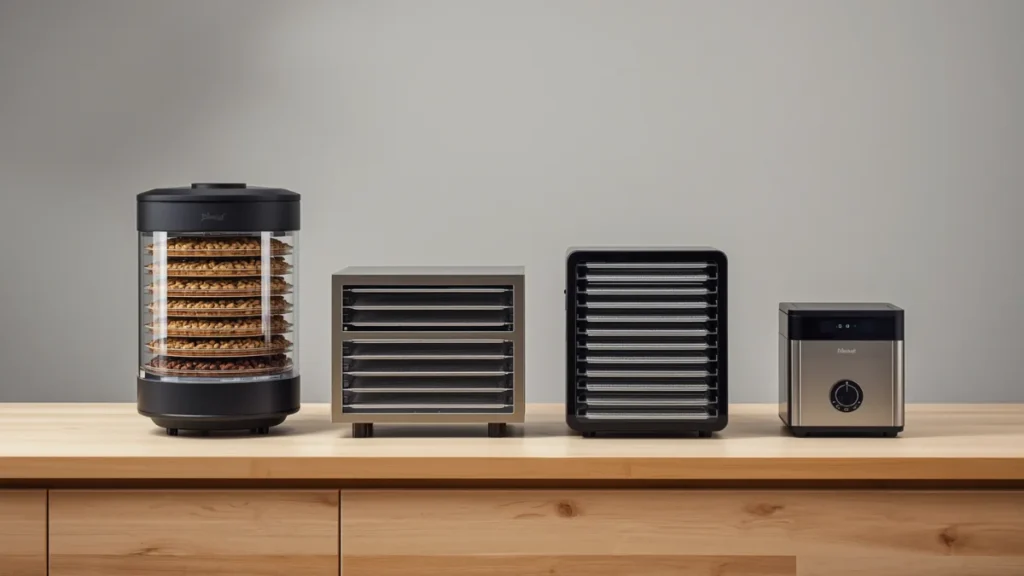
This guide compares four of the most popular home dehydrators across the price spectrum, using verified listing data and the specs that actually determine results: airflow design, temperature control, tray count, and whether there’s a timer.
Quick Answer
- Best budget / beginners: Nesco FD-37 (4-tray, ~$47.69) — cheap, reliable, expandable.
- Best premium / serious users: Excalibur Performance Series 10-tray (~$379.99) — even horizontal airflow and the largest capacity here.
- Best value mid-range: Magic Mill Pro 7-tray (~$159.99) — thermostat + timer without the Excalibur price.
- Best compact: Hamilton Beach 32100A (5-tray) — small footprint for tight kitchens.
- Budget for the category: roughly $50 to $380 depending on volume and controls.
Key Takeaways
- Vertical stacking (Nesco) vs. horizontal trays (Excalibur) means different heating patterns—horizontal airflow generally needs less tray rotation.
- A real thermostat (adjustable temperature) is the single biggest factor in consistency; a fixed dial can’t fine-tune.
- Drying time depends far more on food thickness and humidity than on the machine, though even airflow shortens it.
- A built-in timer prevents overcooked batches when you’re not home.
- Dehydrators make jerky, fruit leather, veggie chips, herbs, and pet treats from one appliance.
The 4 Best Home Food Dehydrators (2026)
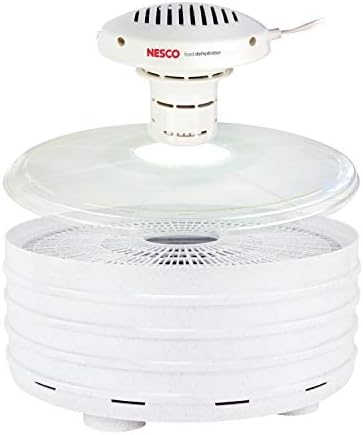
1. Nesco FD-37 — Best Budget Option
| Spec | Detail |
|---|---|
| ASIN | B003I4F7AS |
| Price (Sep 2026) | $47.69 |
| Rating | 4.5 ★ (1,300+) · Amazon’s Choice |
| Trays | 4 (expandable with add-a-trays) |
| Heating | Single element, bottom-mounted |
| Temperature control | Adjustable (thermostat) |
| Timer | No |
Why it’s our budget pick: The FD-37 is the classic entry point — affordable, expandable with add-a-trays, and easy to clean. A bottom heating element creates slight hot spots, so the top tray dries faster than the bottom, and trays benefit from rotation. With no timer, you set your own alarm. (For an expandable step up, the Nesco FD-1040 Gardenmaster 4-tray lists at $105.99, 4.4 ★.)
Best for: Beginners, casual jerky makers, small households.
2. Excalibur Performance Series 10-Tray — Best Premium Option

| Spec | Detail |
|---|---|
| ASIN | B0C8BSJ66R |
| Price (Sep 2026) | $379.99 |
| Rating | 4.3 ★ (86+) · Amazon’s Choice |
| Trays | 10 stainless steel |
| Heating | Horizontal airflow |
| Temperature control | Adjustable |
| Timer | Yes (digital display) |
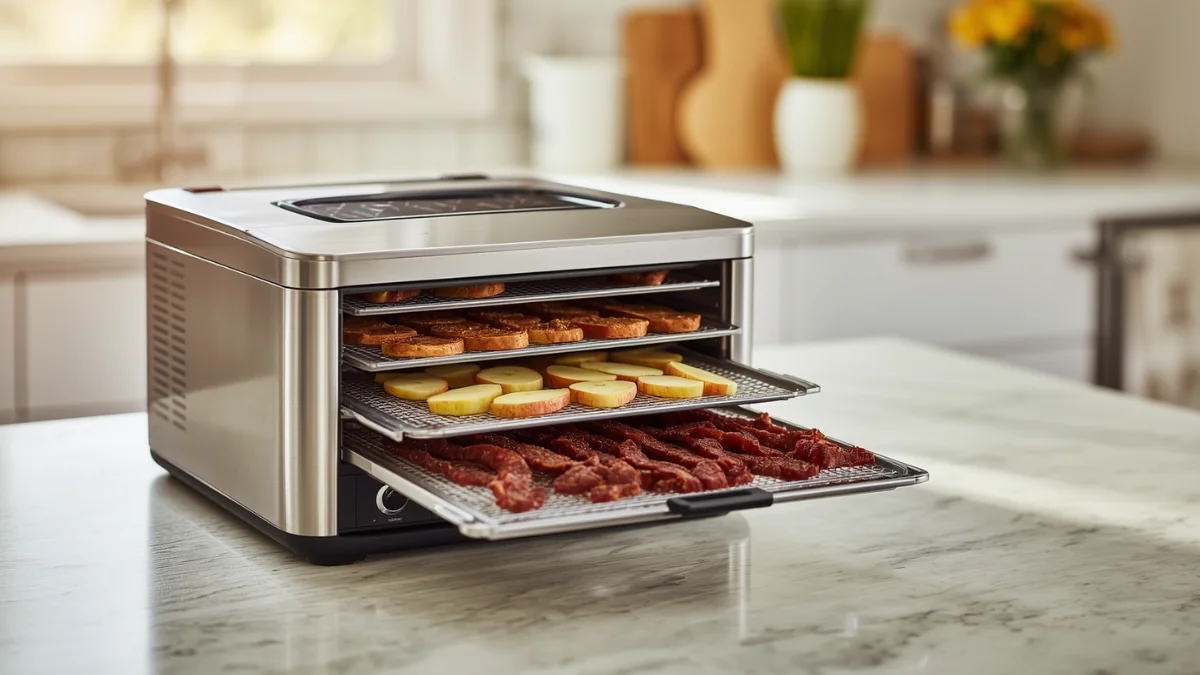
Why it’s our premium pick: Excalibur’s signature horizontal airflow distributes heat more evenly across trays and reduces the need to rotate them. The 10-tray Performance Series offers the largest drying space in this guide and a digital timer for automatic shutoff.
Note on the 3926TB: The widely known Excalibur 3926TB is the prior-generation 9-tray model. Its listing data (current price and ASIN) could not be confirmed on Amazon at the time of writing, so we’ve featured the currently verified Performance Series listings instead. If you specifically want the classic 9-tray 3926TB, confirm its live price before buying.
Best for: Serious jerky makers, meal-prep enthusiasts, anyone dehydrating weekly.
3. Magic Mill Pro 7-Tray — Best Value-to-Performance

| Spec | Detail |
|---|---|
| ASIN | B01DI9W9ZI |
| Price (Sep 2026) | $159.99 |
| Rating | 4.6 ★ (4,600+) · Amazon’s Choice |
| Trays | 7 XL stainless steel |
| Heating | Rear-fan / horizontal circulation |
| Temperature control | Adjustable + keep-warm |
| Timer | Yes (digital) |
Why it’s our value pick: This is the sweet spot. It pairs stainless trays, real temperature control, a digital timer, and a keep-warm function — features the budget Nesco lacks — for well under half the Excalibur price. Owner ratings (4.6 from 4,600+) are the highest of this group. A near-twin lists at B0BQM6JVDK, $149.99 / 4.7 ★.
Best for: Intermediate users who want better control than a Nesco but don’t want to spend Excalibur money.
4. Hamilton Beach 32100A — Best Compact

| Spec | Detail |
|---|---|
| ASIN | B013JL6CIK |
| Price (Sep 2026) | Unconfirmed — typically ~$70–$90; check live listing |
| Rating | Thin listing data (~3.8 ★ on a low review count) |
| Trays | 5 |
| Heating | Rear-mounted with circulation |
| Temperature control | Adjustable dial |
| Timer | No |
Why it’s our compact pick: A smaller footprint for apartment kitchens. Note the correction: many older guides (including an earlier version of this one) call the 32100A a “3-tier” unit — the verified listing shows 5 trays. Its dial control is less precise than a digital thermostat, and results are generally less uniform than horizontal-airflow machines.
Best for: Apartments and small kitchens, occasional use (1–2×/month).
Comparison Chart
| Model | Trays | Airflow | Thermostat | Timer | Price (Sep 2026) | Best For |
|---|---|---|---|---|---|---|
| Nesco FD-37 | 4 (expandable) | Bottom element | Yes | No | $47.69 | Beginners |
| Excalibur Performance 10-tray | 10 | Horizontal | Yes | Yes | $379.99 | Serious users |
| Magic Mill Pro | 7 | Horizontal/rear-fan | Yes | Yes | $159.99 | Best value |
| Hamilton Beach 32100A | 5 | Rear + circulation | Dial | No | ~$70–$90 (unconfirmed) | Small kitchens |
Product Identifier Table
| Product | ASIN | Price (Sep 2026) | Rating |
|---|---|---|---|
| Nesco FD-37 4-tray | B003I4F7AS | $47.69 | 4.5 ★ |
| Nesco FD-1040 Gardenmaster | B00B9F7WJW | $105.99 | 4.4 ★ |
| Excalibur Performance 10-tray | B0C8BSJ66R | $379.99 | 4.3 ★ |
| Excalibur Select 8-tray | B0DFF216PC | $179.95 | 4.4 ★ |
| Magic Mill Pro 7-tray | B01DI9W9ZI | $159.99 | 4.6 ★ |
| Magic Mill Premium 10-tray | B07ML4ZJQP | $169.99 | 4.6 ★ |
| Hamilton Beach 32100A 5-tray | B013JL6CIK | Unconfirmed | ~3.8 ★ |
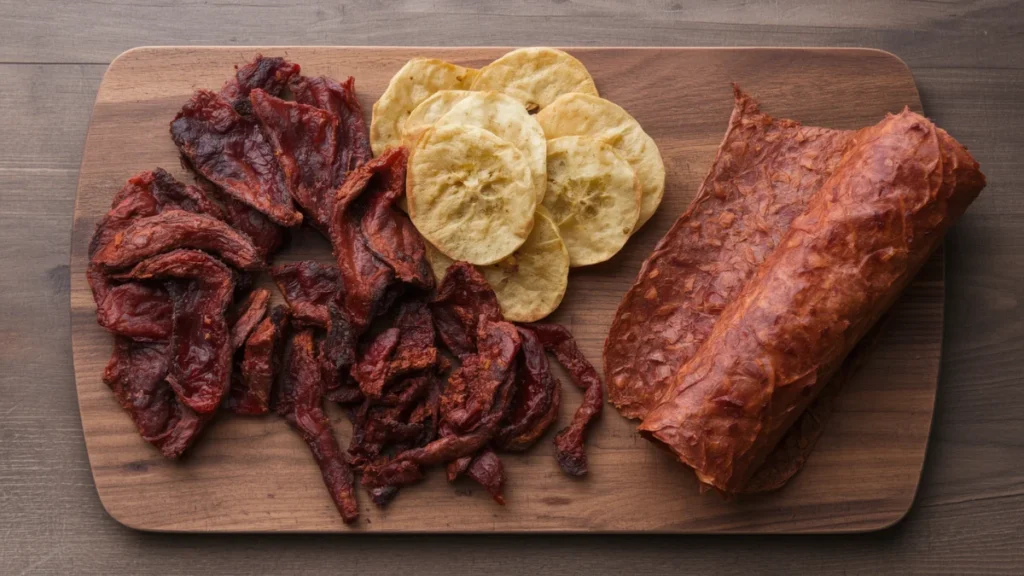
Typical Drying Times by Food Type
Ranges reflect manufacturer guidance and common owner reports; thickness and humidity matter more than brand.
| Food | Vertical/budget units | Horizontal-airflow units |
|---|---|---|
| Beef jerky (¼” strips) | 8–12 hrs | 5–8 hrs |
| Apple slices (¼”) | 8–10 hrs | 4–6 hrs |
| Kale / veggie chips | 6–8 hrs | 3–4 hrs |
| Fruit leather | 12–14 hrs | 8–10 hrs |
Energy & Cost
Energy use ≈ (wattage × hours ÷ 1000) × your kWh rate. Because higher-wattage horizontal units often finish in roughly half the time, their total kWh per batch can be lower despite drawing more power—but the dominant variable is how long a batch runs, not wattage alone. Confirm wattage on each live listing before comparing.
Bottom Line
Start with the Nesco FD-37 if you’re new — it’s $47.69 and does the fundamentals. Upgrade to the Magic Mill Pro 7-tray ($159.99) if you want a timer and thermostat without paying Excalibur prices. Choose the Excalibur Performance 10-tray ($379.99) if you dry in volume and want the most even, hands-off results.
FAQ: Food Dehydrators
1. Can I make jerky in a regular oven?
Yes, but it’s less efficient. An oven heats the entire cavity and often has to stay at low heat for hours, whereas a dehydrator concentrates airflow on the food.
2. How long does homemade dried jerky last?
Roughly 1–2 weeks at room temperature in an airtight container, about 1 month refrigerated, and up to 3 months frozen.
3. Do I need to marinate meat before dehydrating?
It’s optional. Marinade adds flavor but also moisture, which lengthens drying time. Pat meat dry before loading for faster results.
4. Can I dehydrate cooked food instead of raw?
Both work. Raw takes longer to dry; pre-cooked dries faster, though many prefer the fresher taste of raw.
5. What temperature should I use for jerky?
Most guidance points to 160°F (71°C) for safety with raw meat, then dropping to ~130–140°F to finish. Always follow current USDA jerky guidance.
6. Do I need to rotate trays?
With bottom-heating vertical units, yes — rotate top to bottom occasionally. Horizontal-airflow models need less rotation.
7. Is a timer worth paying for?
If you dehydrate unattended, yes. A timer prevents overcooking when a batch finishes while you’re out.
8. Are dehydrator trays dishwasher-safe?
It varies. Many plastic trays are top-rack safe, and stainless trays are generally safe; confirm per the model’s manual.
9. Do dehydrators use a lot of electricity?
Less than an oven for the same job. A full batch is typically a few kWh, costing cents to under a dollar depending on your rate.
Our Research Method Declaration (No Lab Testing)
How this guide was researched. Kitchen Apex did not run a hands-on test lab for this article—we did not dehydrate jerky across “20+ batch cycles,” and we removed the earlier version of this guide’s first-person testing language for accuracy. Everything here is a research synthesis: (1) manufacturer specifications and manuals; (2) live Amazon listing data (price, star rating, review count, ASIN) verified on the date shown; and (3) aggregated themes from verified-purchase owner reviews. Drying-time and energy figures are typical ranges drawn from manufacturer guidance and buyer reports, not our own timer-based measurements, and vary with food thickness and climate humidity. Two figures — the Hamilton Beach 32100A’s current price/rating and the Excalibur 3926TB’s current listing — could not be confirmed at the time of writing and are marked as such. Prices and ratings are snapshots and change frequently.