Published: June 9, 2026 | Reviewed against US DOE, ENERGY STAR, and EIA data
The Question Worth Asking
You use these appliances every day. But do you know what they cost to run?
Most people assume wattage tells the whole story. It doesn’t. A 1,500-watt air fryer used for 20 minutes costs far less to run than a 600-watt coffee maker left on a warming plate for two hours.
What actually matters is wattage multiplied by time — that is your real electricity cost.
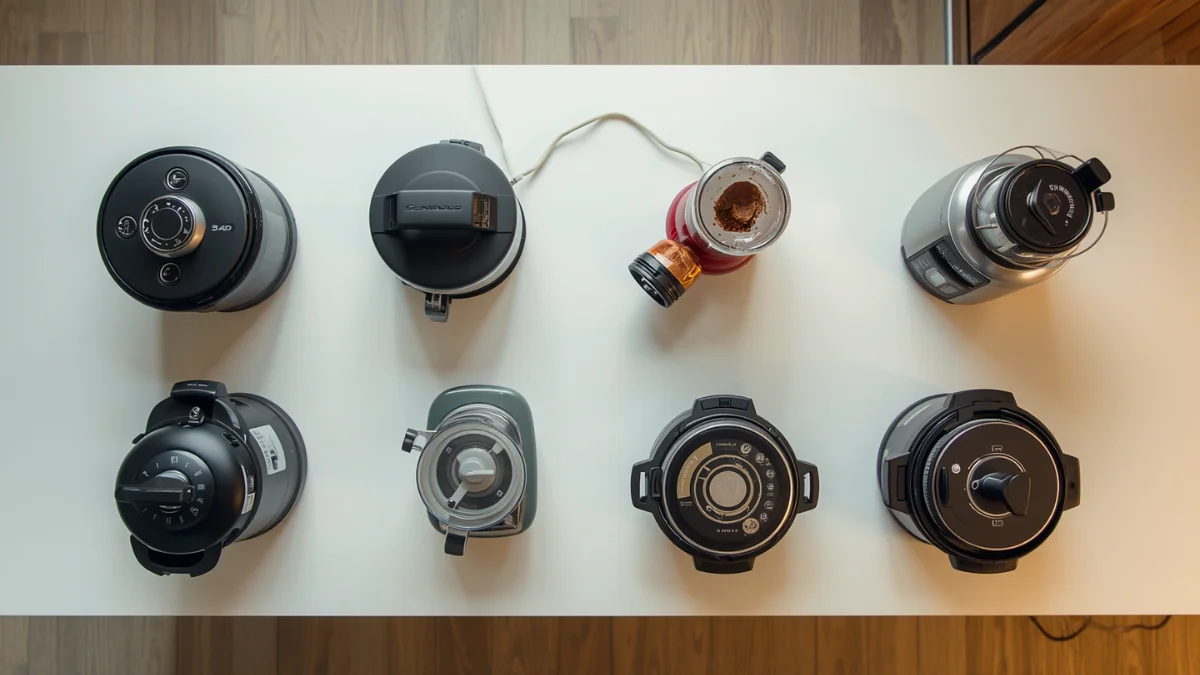
This guide covers eight common kitchen appliances — their typical wattage ranges, how much they cost per use, and the habits that quietly inflate your energy bill.
All costs are based on the US average electricity rate of $0.18 per kWh as of December 2025 (US Energy Information Administration).
How to Read This Guide
Wattage tells you how much power an appliance draws while running.
kWh (kilowatt-hour) is what your utility bill measures. To convert:
(Watts × Hours used) ÷ 1,000 = kWh
Cost per use is kWh × your electricity rate.
For example: a 1,500-watt air fryer running for 20 minutes (0.33 hours):
1,500 × 0.33 ÷ 1,000 = 0.5 kWh = ~$0.09 per use
Quick Reference — All Eight Appliances
| Appliance | Typical Wattage | Avg. Session | Cost Per Use* | Annual Est.* |
|---|---|---|---|---|
| Air fryer | 800–2,000W | 20–30 min | $0.05–$0.18 | $18–$65 |
| Countertop / toaster oven | 1,200–1,800W | 20–45 min | $0.07–$0.24 | $25–$88 |
| Coffee maker (drip) | 600–1,200W | 8–10 min brew | $0.01–$0.04 | $4–$15 |
| Pressure cooker | 700–1,200W | 20–40 min | $0.04–$0.14 | $15–$51 |
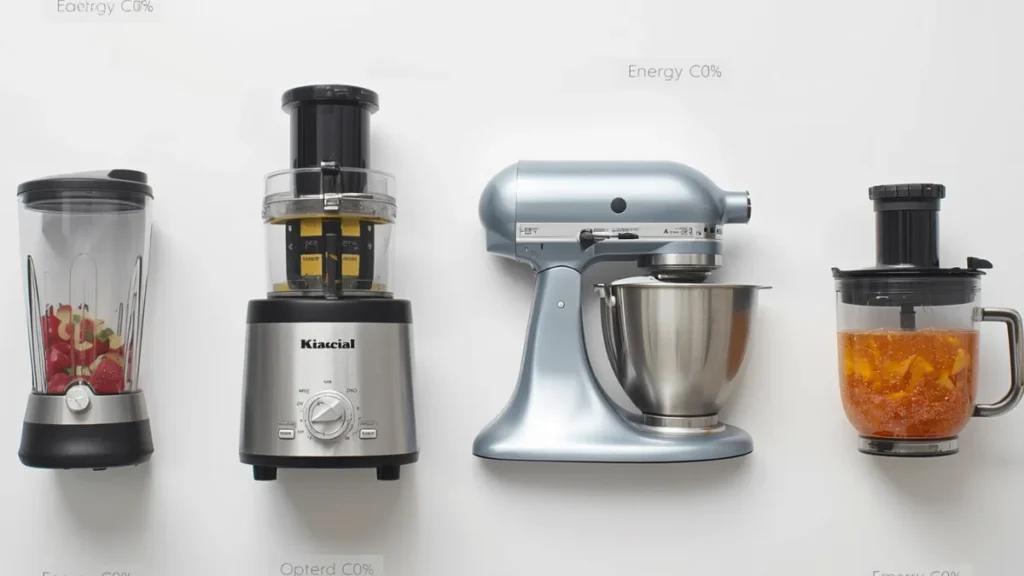
| Blender | 300–1,500W | 1–3 min | Under $0.01 | $2–$5 |
| Juicer (centrifugal) | 400–1,000W | 5–10 min | $0.01–$0.03 | $4–$11 |
| Stand mixer | 250–600W | 5–15 min | Under $0.01 | $2–$5 |
| Food processor | 350–1,200W | 3–10 min | Under $0.01 | $3–$8 |
Based on daily use and $0.18/kWh US average. Actual costs vary by location and usage frequency.
1. Air Fryer — Efficient Relative to What It Replaces
Typical wattage: 800–2,000W Average session: 20–30 minutes Cost per use: $0.05–$0.18
On average, an air fryer uses 1.4 kilowatt-hours (kWh) per hour, costing about $0.23 at current US electricity rates. Compared to an electric oven, which uses 3.5 kWh per hour, air fryers use less than half the energy.
The key word there is per hour. Most air fryer sessions run 15–25 minutes — not a full hour. If a 1,500-watt air fryer is used for 20 minutes, it consumes only about 0.5 kWh of electricity. That works out to roughly $0.09 per session.
For most households, an air fryer used 30 minutes daily will add $2–$8 to monthly electricity bills, making them a cost-effective cooking solution.
What affects energy use most:
- Size matters. A 2-quart air fryer may use around 800–1,400 watts, while a 6-quart or dual-basket air fryer may use 1,200–1,800 watts.
- Preheating. Many air fryer models don’t require preheating — skipping it saves 2–3 minutes of wattage draw per session.
- Temperature. Higher temperatures mean more energy drawn per minute.
Practical tip: For meals with fewer than 4 servings, the air fryer will almost always use less electricity than a full-size oven. For reheating tasks where texture doesn’t matter, a microwave uses even less.
2. Countertop / Toaster Oven — The Smarter Oven Choice
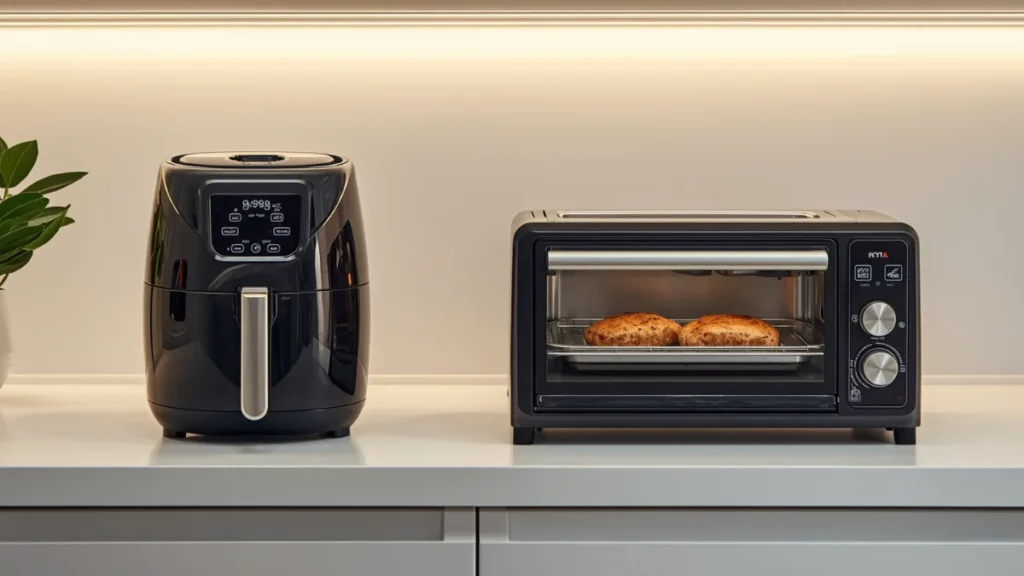
Typical wattage: 1,200–1,800W Average session: 20–45 minutes Cost per use: $0.07–$0.24
According to industry representatives, a toaster oven uses about one-third to one-half as much energy as a conventional electric oven for cooking small meals. Typical power consumption during use is 1,200 to 1,400 watts.
Compare that to a full-size oven drawing 2,000–5,000 watts — and the difference compounds fast for daily cooking tasks.
Air fryer expert Clare Andrews explains: “Air fryers are typically rated between 1,200 and 1,800 watts, while toaster ovens can range from 1,200 up to 2,400 watts depending on size and features.”
There is meaningful overlap between the two — which is why session length and preheating behavior matter more than headline wattage for comparing these two appliances.
What affects energy use most:
- Convection fan. Models with convection use slightly more wattage but cook faster — typically reducing total energy use per meal.
- Temperature setting. Most countertop ovens use less energy at lower temperatures for tasks like warming and toasting.
- Door opening. Each time the door opens, heat escapes and the heating element works harder to recover.
Practical tip: For single-portion baking, reheating, or toasting, a countertop oven consistently outperforms a full-size oven on energy. For anything that fills a 9×13 pan or larger, a full oven may actually be more efficient per unit of food cooked.
3. Coffee Maker — Watch the Warming Plate
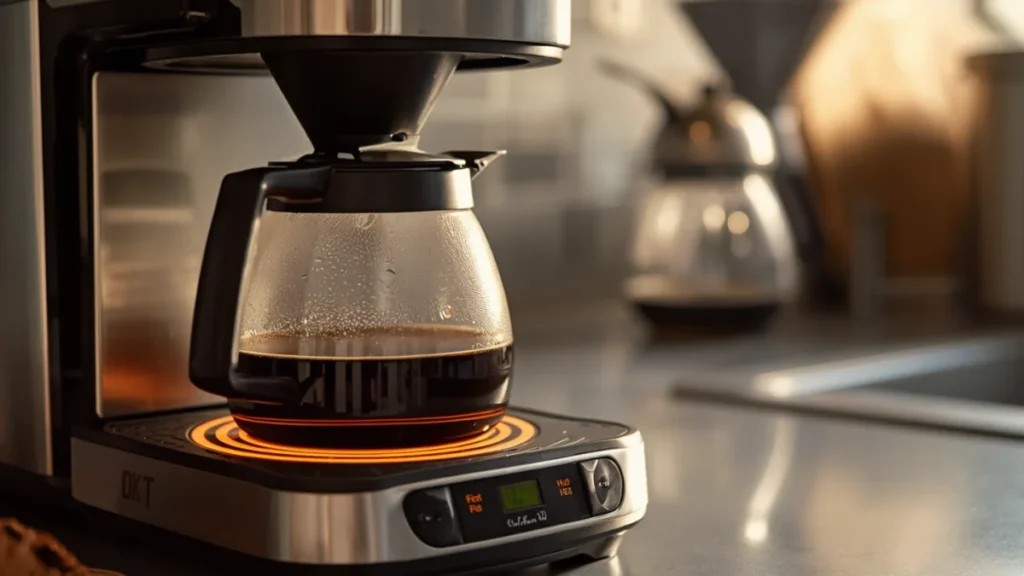
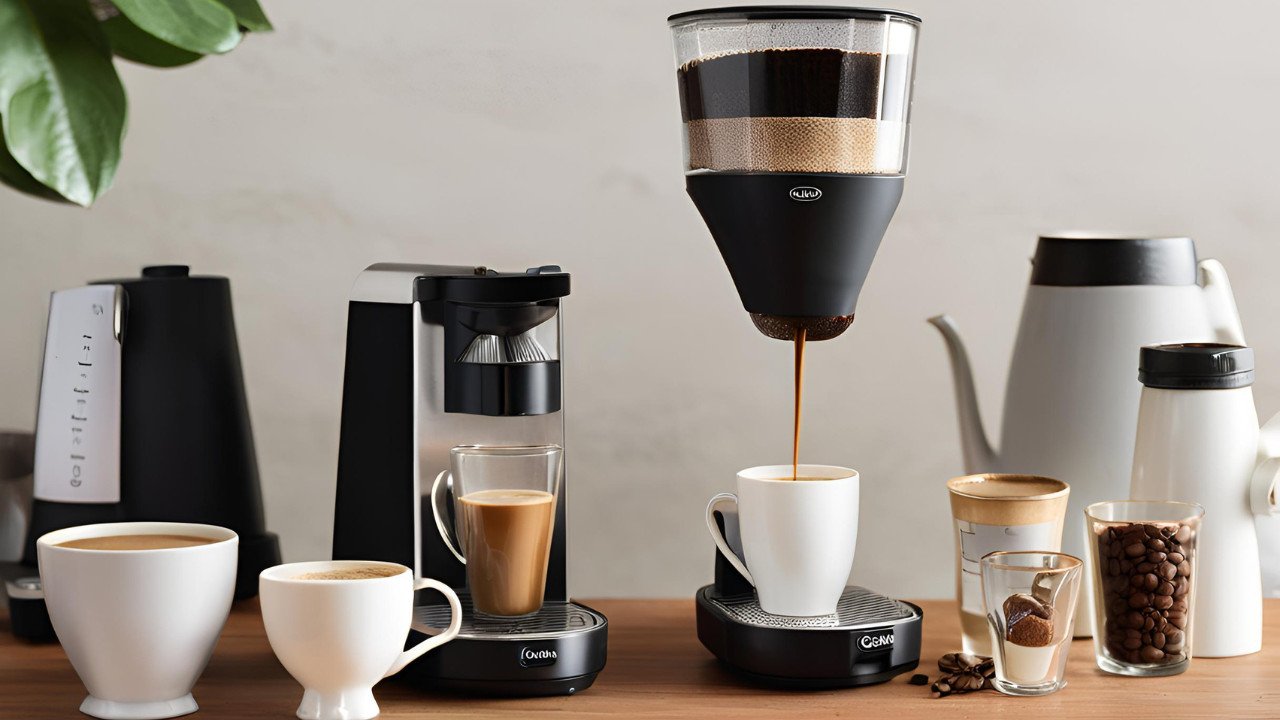
Typical wattage: 600–1,200W (brewing) | 60–100W (warming plate) Average brew session: 8–10 minutes Cost per brew cycle: $0.01–$0.04
The brewing cycle itself is not the energy problem with drip coffee makers.
A typical drip machine draws 600–1,200 watts for 8–10 minutes to brew. That costs between $0.01 and $0.04 per pot. Across a full year of daily brewing, that’s roughly $4–$15.
The real issue is the warming plate.
Many drip coffee makers keep their warming plate on for 30–120 minutes after brewing. That plate draws 60–100 watts continuously. If it runs for 2 hours daily, it adds approximately 73 kWh per year — costing around $13 at current rates.
In some households, the warming plate uses more electricity annually than the brewing cycle does.
What affects energy use most:
- Warming plate duration. The longer the plate stays on, the higher the real cost.
- Pod machines. Single-serve pod machines brew faster with similar wattage — less total energy per cup.
- Standby draw. Machines with digital displays draw 1–5 watts 24 hours a day even when idle.
Practical tip: Use a thermal carafe coffee maker — it keeps coffee hot without any electricity after brewing. If you have a warming plate model, unplug it or connect it to a timer outlet immediately after pouring.
4. Pressure Cooker — Deceptively Efficient
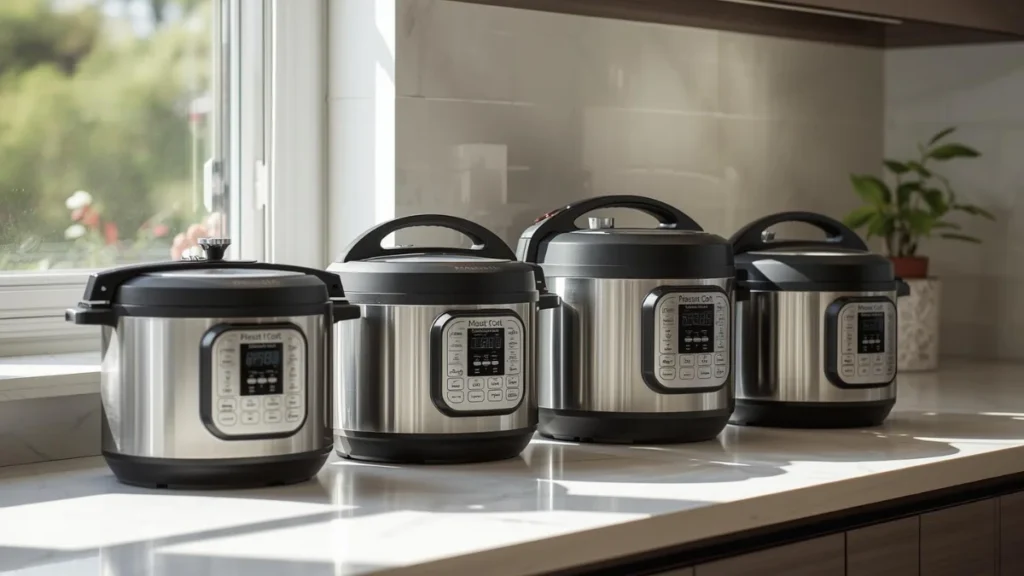
Typical wattage: 700–1,200W Average session: 20–40 minutes (including pressurization) Cost per use: $0.04–$0.14
Smaller pressure cooker models (3 quarts) use around 700 watts, while larger models (8 quarts) will use 1,200 watts. The main function of a pressure cooker is to take 5–10 minutes to build up pressure in the sealed pot, then cook the food — typically faster than other methods.
The efficiency story here is compelling. A dish that takes 90 minutes in a conventional oven can often be done in 20–25 minutes under pressure. That’s a significant reduction in total energy consumption — even if the in-use wattage is similar to that of other appliances.
Slow cookers draw even less — typically 75–150 watts on low and 150–210 watts on high — but run for 4–8 hours. Total energy per meal is comparable to that of a pressure cooker in most cases.
What affects energy use most:
- Pressurization time. The unit draws full wattage during heat-up. Recipes that need repeated pressure cycles use more energy.
- Pot size. Larger pots take longer to pressurize, drawing energy for longer before cooking begins.
- Keep-warm function. Many electric pressure cookers default to keep-warm after cooking. This draws 20–40 watts continuously — worth switching off if the meal is ready.
Practical tip: For soups, stews, legumes, and grains, a pressure cooker is one of the most energy-efficient cooking methods available. The combination of speed and sealed cooking makes it consistently more efficient than stovetop or oven methods for these food types.
5. Blender — Low Cost, Easy to Overlook
Typical wattage: 300–1,500W Average session: 1–3 minutes Cost per use: Under $0.01
Blenders have some of the highest wattage ratings in the small appliance category. High-performance models like Vitamix run at 1,500–2,400 watts. That sounds alarming until you look at session length.
A 1,500-watt blender running for 60 seconds uses 0.025 kWh — less than a penny per smoothie. Even daily smoothies for a year cost about $3 in electricity. The blender isn’t the source of your kitchen energy bill.
For average household use and the occasional preparation of smoothies, soups, and sauces, a blender with a wattage of between 300 and 700 watts is sufficient.
What affects energy use most:
- Session length. A blender used for 30 seconds costs a fraction of one used for 3 minutes.
- Speed setting. Higher speeds draw more watts per second.
- Ingredient hardness. Blending ice, frozen fruit, or nuts causes the motor to work harder and draw more current.
Practical tip: Higher wattage blenders actually complete tasks faster — often consuming similar or less total energy than lower-wattage models that struggle and run longer. For smoothies and everyday blending, 500–700W is sufficient for most households.
6. Juicer — Type Changes Everything
Typical wattage: 150–1,000W (varies significantly by type) Average session: 5–10 minutes Cost per use: $0.01–$0.03
Juicers split cleanly into two categories with very different energy profiles.
Centrifugal juicers spin at up to 18,000 RPM using 400–1,000 watts. They juice fast — typically for 5 minutes or less — and use a moderate total energy intake per session.
Masticating (cold-press) juicers spin at 100–400 RPM and draw 150–400 watts. They take longer — 10–15 minutes — but at much lower wattage. Total energy per session is often similar to centrifugal models despite the lower wattage.
The normal power for a basic juicer is 150W. If you make orange juice every day and it takes 3 minutes, you will consume 0.2 kWh per month. That works out to approximately $0.44 per year at current rates — making the juicer one of the lowest-cost appliances in this entire category.
What affects energy use most:
- Produce type. Hard vegetables like carrots and beetroot require more motor effort than soft citrus fruit.
- Session duration. Cold press juicers run longer per batch but at lower wattage.
- Cleaning cycle. Some users run the juicer briefly with water to clear the chute — adding a small additional energy draw.
Practical tip: From a pure energy perspective, neither juicer type is a meaningful electricity concern. The choice between centrifugal and masticating should be based on juice quality, noise, and yield — not energy cost.
7. Stand Mixer — Surprisingly Modest
Typical wattage: 250–600W Average session: 5–15 minutes Cost per use: Under $0.01
A stand mixer uses an average of 350 watts while running. For a 10-minute mixing session, that’s 0.058 kWh — less than a penny per use.
Even for frequent bakers using a stand mixer daily, the annual electricity cost is unlikely to exceed $5. Stand mixers are among the most energy-efficient appliances in this category, largely because they combine moderate power draw with short mixing times.
What affects energy use most:
- Speed setting. Higher speed settings draw more current.
- Dough vs. whipping. Kneading thick bread dough causes the motor to work harder than whipping cream, drawing more watts during the session.
- Session length. Extended mixing tasks — like kneading for 10+ minutes — add up more than short mixing tasks.
Practical tip: The stand mixer’s energy footprint is so small that energy efficiency should not factor into purchasing decisions. Choose based on capacity, attachments, and durability.
8. Food Processor — Short Sessions, Low Cost
Typical wattage: 350–1,200W Average session: 3–10 minutes Cost per use: Under $0.01
Food processors sit between blenders and stand mixers in their energy profile. They use more wattage than stand mixers (due to blade and disc attachments) but typically run for shorter sessions than either.
A 700-watt food processor running for 5 minutes uses approximately 0.058 kWh per session. At daily use, annual cost is roughly $3–$8 depending on session length and wattage.
What affects energy use most:
- Task type. Chopping and slicing require less processing than dough or thick paste.
- Bowl size. Larger bowls with more powerful motors draw more watts.
- Pulse vs. continuous. Pulse mode draws full power only during each burst — resulting in lower total energy than continuous operation.
Practical tip: For most household tasks, 600–750W is sufficient. Higher wattage processors are worth the additional draw for heavy tasks like pastry dough or large batches — they complete the work faster, often using similar total energy.
The Real Energy Story — It’s About Habit, Not Just Wattage
Looking at all eight appliances together, a pattern emerges.
The appliances with the highest wattage — air fryers, countertop ovens — are not necessarily the most expensive to run. Their sessions are short and purposeful. They turn off when cooking is done.
The real energy drain is:
Warming plates that stay on. Coffee maker warming plates, pressure cooker keep-warm functions, and countertop oven keep-warm settings draw continuous low wattage that adds up over weeks and months.
Standby draws. Appliances with digital displays and clocks draw 1–7 watts 24 hours a day. A single appliance with a 5-watt standby draw costs about $8 per year just to sit plugged in.
Frequency, not just wattage. A 350-watt stand mixer used once a week costs far less than a 700-watt juicer used three times a day.
Understanding your own usage pattern is more valuable than knowing the wattage number on the spec sheet.
How to Calculate Your Actual Cost
The formula is straightforward:
(Watts ÷ 1,000) × Hours used × Electricity rate = Cost
Example — air fryer, 25 minutes daily: (1,500 ÷ 1,000) × 0.417 × $0.18 = $0.11 per day / $40 per year
Example — coffee maker warming plate, 90 minutes daily: (80 ÷ 1,000) × 1.5 × $0.18 = $0.02 per day / $7.88 per year
Example — stand mixer, 10 minutes, 3 times per week: (350 ÷ 1,000) × 0.167 × $0.18 × 156 sessions = $1.64 per year
The numbers put things in perspective. Blenders, juicers, and stand mixers cost almost nothing to operate annually. Air fryers and countertop ovens are the meaningful electricity consumers in this group — and both are still dramatically cheaper to run than a full-size oven.
Five Energy Habits Worth Building
- Turn off warming plates immediately after pouring — coffee maker, pressure cooker, and countertop oven included.
- Unplug small appliances not used daily, or connect them to a smart power strip to eliminate standby draw.
- Match appliance to portion size — use the air fryer or countertop oven for small meals rather than firing up a full-size oven.
- Skip preheating where possible — air fryers often don’t need it; countertop ovens reach temperature faster than full ovens.
- Use pulse mode on food processors and blenders for tasks that don’t require continuous running.
Frequently Asked Questions
Does an air fryer use a lot of electricity?
Not relative to cooking time. A typical air fryer draws 1,400–1,700 watts, but most sessions last 15–25 minutes. That works out to approximately $0.05–$0.15 per session. Used daily, an air fryer adds roughly $2–$8 per month to a typical household’s electricity bill — significantly less than a full-size oven used for the same cooking tasks.
How much electricity does a coffee maker use per day?
The brewing cycle uses 600–1,200 watts for 8–10 minutes, costing $0.01–$0.04 per pot. The warming plate — if left on — draws 60–100 watts continuously and is often responsible for more electricity use than the brewing cycle itself. A thermal carafe model eliminates the warming plate cost entirely.
Is a pressure cooker more energy-efficient than a stovetop pot?
Yes, in most cases. A pressure cooker seals in heat and dramatically reduces cooking time — a dish that takes 90 minutes on the stovetop can often be done in 20–25 minutes under pressure. Even though the wattage is similar, the much shorter cooking time means significantly less total energy used per meal
Why does wattage alone not tell you the electricity cost?
Wattage tells you the rate of energy consumption while an appliance is running. Total cost depends on the product of wattage and time. A 1,500-watt air fryer used for 20 minutes costs less than a 300-watt warming plate left on for 3 hours. Both session length and habits around standby and warming functions matter as much as the wattage rating.
Which kitchen appliance in this group costs the least to run annually?
Stand mixers, blenders, juicers, and food processors all cost between $2 and $11 per year for typical household use because their usage is short. The blender is often the cheapest — a daily smoothie costs approximately $3 per year in electricity, regardless of whether you use a 700-watt or 1,500-watt model.
Does a countertop oven really save electricity compared to a full-size oven?
Yes. A countertop oven uses 1,200–1,800 watts, compared with 2,000–5,000 watts for a full-size oven. For small portions — a single chicken breast, a tray of vegetables, reheated leftovers — the countertop oven uses one-third to one-half less energy per cooking session. The savings are most significant for daily small-portion cooking.
Small Appliances Energy Comparison