Quick Answer
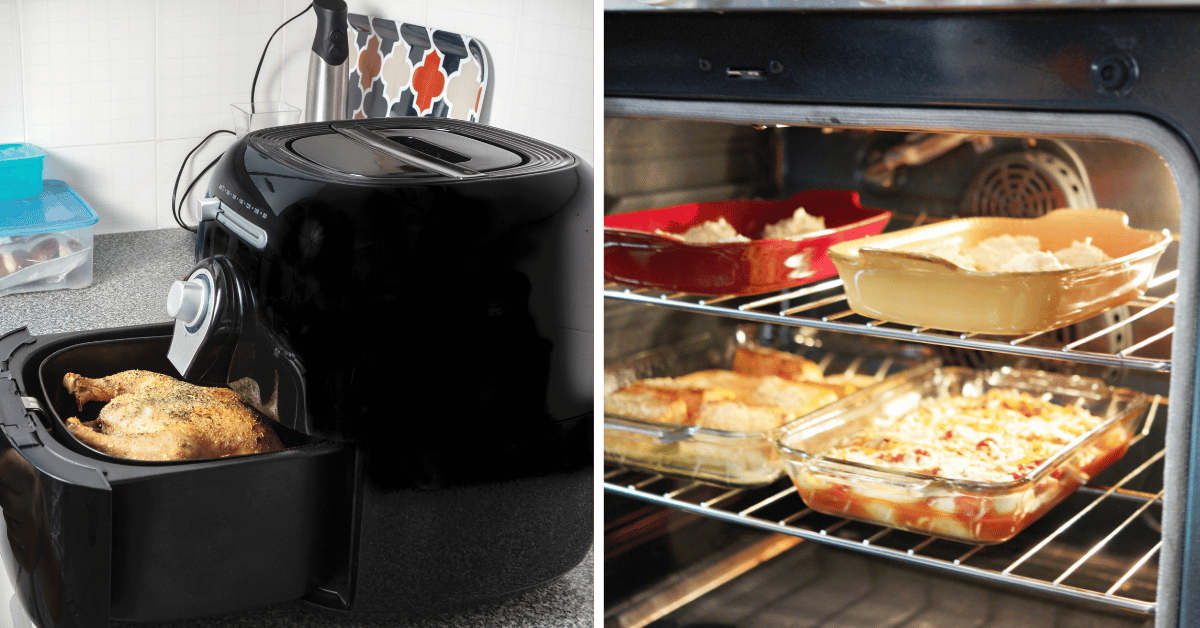
An air fryer is a countertop convection oven that circulates hot air at high speed to cook food. It mimics the results of deep-frying (crispy outside, tender inside) using minimal oil.
The claim of “75% less fat” is real—but so is the learning curve, the noise, and the capacity limitations. They’re worthwhile for people who regularly reheat leftovers or want crispy results from frozen foods. They’re not a complete stovetop replacement.
What Actually Happens Inside an Air Fryer
Air fryers are small, enclosed convection ovens. Here’s the mechanics:
- A heating element (usually at the top or bottom) rapidly heats air to 300–400°F.
- A high-speed fan circulates hot air in tight circles around the food, often at 60+ mph.
- The basket design (perforated metal or ceramic) allows air to reach all sides of the food simultaneously.
- Moisture on the food surface evaporates instantly. This triggers the Maillard reaction—the browning that creates crispy texture and flavor.
This is different from a traditional oven. A regular oven heats the air in the entire box. An air fryer heats and circulates air specifically around the food. This concentrated, moving heat browns food faster and more evenly.
The result: a crispy exterior and a moist interior, without deep-frying in oil.
Why Oil Still Matters
Air fryers work best when there is some oil on the food’s surface. Oil helps transfer heat and accelerates browning. “No oil needed” is a myth. But you use 1–2 tablespoons per batch instead of 2 quarts of oil for traditional frying. Hence the “75% less fat” claim.
Without oil, air-fried food often tastes bland and dries out. With a light oil coating (spray or brush), the results are indistinguishable from shallow-fried food.
Temperature Range and What It Actually Means
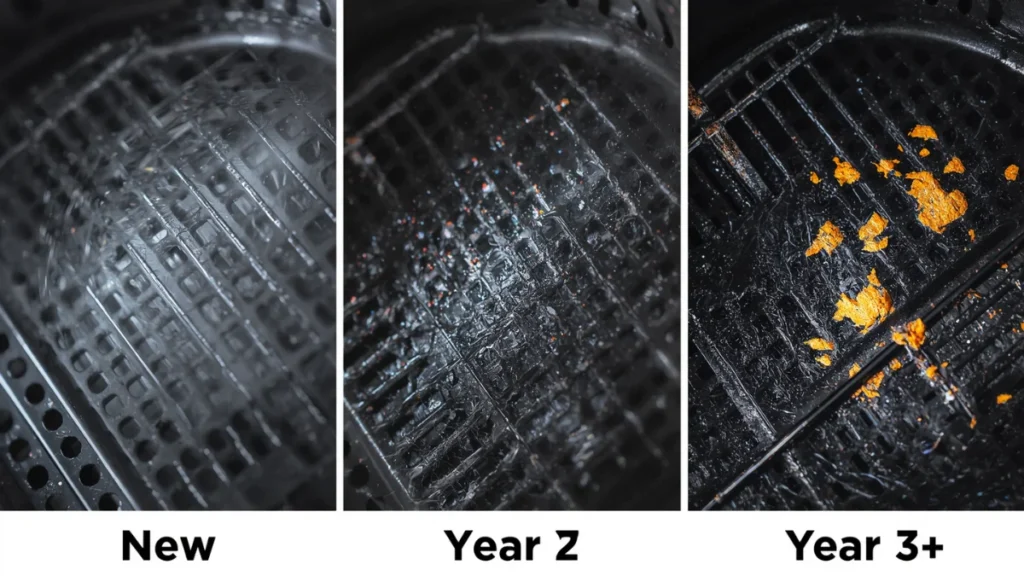
Close-up comparison of air fryer basket non-stick coating condition at different ages: new, after 2 years, after 3+ years
Close-up comparison of air fryer basket non-stick coating condition at different ages: new, after 2 years, after 3+ years
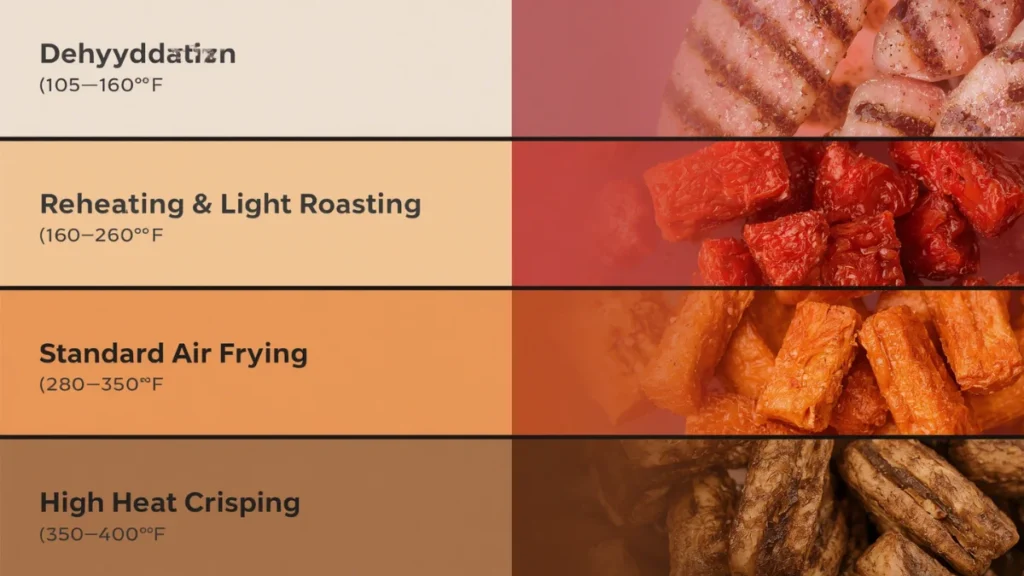
Most air fryers operate between 105°F and 400°F. This range matters more than people realize.
What Different Temperature Bands Do
105°F–160°F: Gentle dehydration. Drying herbs, making jerky, or softly warming cooked food without browning. Slow process. Useful but not a daily task.
160°F–280°F: Reheating and light roasting. Pizza becomes crispy again. Leftover fried chicken regains texture. Vegetables roast gently without burning. Most daily cooking happens here.
280°F–350°F: Standard air frying. Frozen French fries, chicken wings, fish. Most recipes cluster around 350°F. Fast, reliable, and browning evenly.
350°F–400°F: High-heat crisping. Getting extra-crispy exteriors on thicker cuts of chicken or vegetables. Burns can happen if you’re not watching. This is the “fry hard” zone.
The wide range (105°F to 400°F) is a real advantage. You’re not locked into frying food. You can dehydrate, reheat, roast, and fry in one appliance. But you’ll use the 280–350°F band 80% of the time.
Capacity: 4-Quart Reality Check
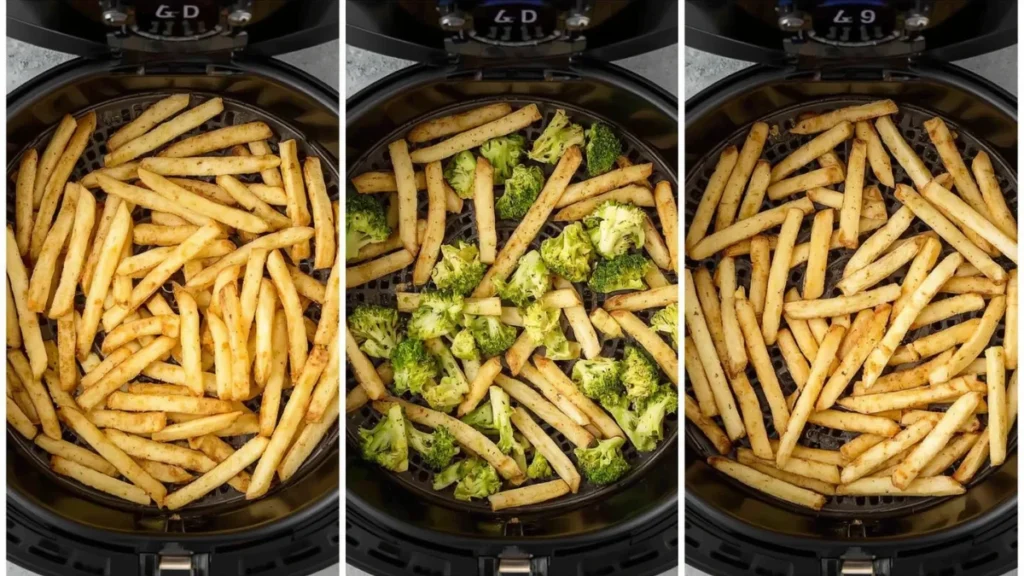
Air fryer baskets range from 2 quarts to 8+ quarts. The Ninja AF101 sits at 4 quarts. Understanding what this means in practice saves regret.
What 4 Quarts Actually Holds
- Single serving: 1–2 cups of food (e.g., 4 chicken wings, a handful of fries, one portobello mushroom).
- Two servings: ~2–3 cups of food (e.g., 8 pieces of broccoli, 6 oz chicken breast, a small handful of fries).
- Light family meal: ~3–4 cups (e.g., a whole small chicken leg + thighs, two salmon fillets, a medium pile of vegetables).
- Multiple batches required: Anything beyond that.
The Honest Trade-Off
A 4-quart air fryer is perfect for:
- Single person or couple.
- Reheating leftovers (the machine’s best use case).
- Cooking frozen snacks (fries, wings, fish sticks).
- Daily vegetable roasting.
A 4-quart air fryer is limiting for:
- Family of 4+ needing one batch.
- Meal-prepping bulk protein.
- Cooking a full rotisserie chicken.
- Hosting.
If you often cook for 4+ people, a 6–8 quart model reduces batching. But it takes more counter space and takes longer to preheat. There’s no “perfect” size—only the right size for your household.
Preheat Time and Temperature Accuracy
Most modern air fryers preheat to 350°F in 3–5 minutes. This is faster than a traditional oven (which takes 15–20 minutes). But it’s important to understand what’s happening.
Preheating brings the heating element and basket to temperature. But the air inside isn’t actually uniform until the fan has been running for a minute or two. Starting food during preheating can result in uneven browning—the bottom may cook faster than the top.
Best practice: Preheat fully, then add food. It takes 3 minutes of actual waiting. Most people skip this step and live with slightly uneven results.
Temperature sensors in air fryers vary in accuracy. Budget models can drift ±25°F. Premium models stay within ±5°F. This matters if you’re making delicate items (like dried herbs or low-temp jerky). For everyday frying and roasting, ±25°F is fine—you won’t notice the difference.
Cleaning and Maintenance: The Honest Picture
Air fryer baskets have non-stick ceramic or Teflon coatings. They’re easier to clean than cast iron, but they degrade.
What Damages Non-Stick Coatings
- Metal utensils (scrubbing with metal forks or knives).
- High-temperature dishwasher cycles.
- Acidic foods (tomato-based sauces can pit the coating over years.
- Abrasive scrubbers.
Realistic Lifespan
A ceramic-coated basket lasts 3–5 years with regular use and gentle care. After that, the coating flakes or becomes scratched, and food sticks more. You can replace the basket (usually $15–30), or replace the entire machine.
The Real Cleaning Time
Hand-washing a basket and crisper plate takes 2–3 minutes—faster than a baking sheet. Dishwasher-safe parts are convenient, but they shorten coating life. Hand-washing extends the machine’s lifespan.
Many people air-fry leftovers (pizza, fries) that leave minimal residue. Those sessions take 30 seconds to wipe down. Fatty foods (chicken skin, burgers) need to be washed properly. Plan accordingly.
Noise and Ventilation Reality
Air fryers are loud. The high-speed fan creates noise at 70–85 decibels—roughly the volume of a busy restaurant. This isn’t a design flaw; it’s essential to the cooking method.
Real impact:
- Early morning use (before 7 AM) is annoying to household mates.
- Apartment living means your neighbors might hear it during peak hours.
- If you’re noise-sensitive, run it during busier times of day.
Ventilation matters: Air fryers exhaust hot air and steam. Place the machine at least 5 inches from walls or cabinets. Running it against a wall or under a cabinet can damage paint or create heat buildup. Poor ventilation can also trigger smoke alarms if you’re cooking fatty foods (chicken skin, thick burgers).
Most people place air fryers on kitchen counters. If counter space is tight, they’re still compact enough (roughly 8.5 x 12 x 11 inches for a 4-quart model). But “leave it out during cooking and put it away when done” isn’t realistic—the preheat and cooldown times add up.
When Air Fryers Are Worth Buying (Honest Assessment)
Best Use Cases
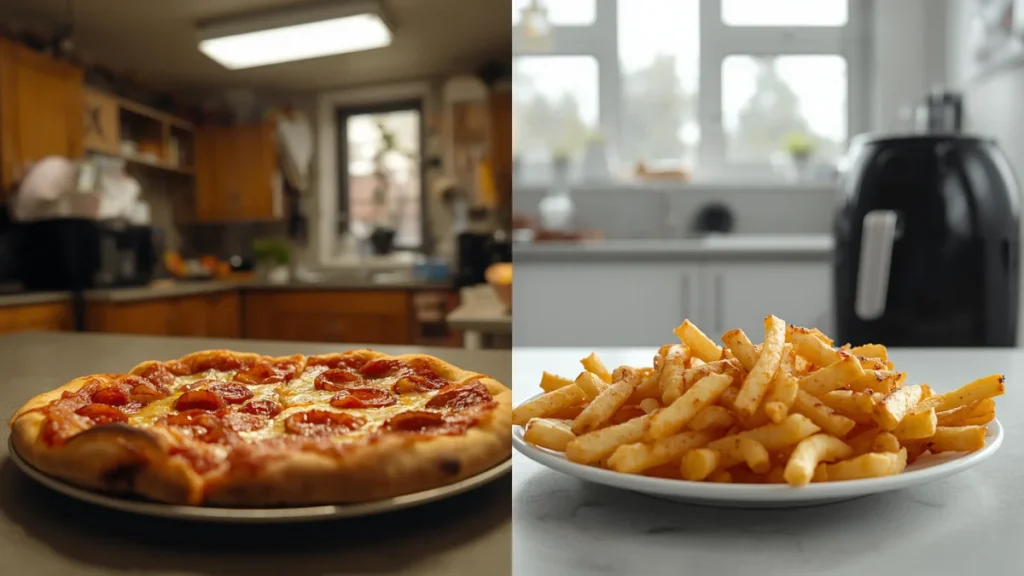
Reheating leftovers: This is where air fryers excel. Pizza, fries, fried chicken, and bread all regain a crispy texture that microwaves ruin. If you have consistent leftovers, an air fryer pays for itself in convenience.
Frozen snacks and quick meals: Frozen fries, fish sticks, chicken wings, and spring rolls cook perfectly in 8–12 minutes with minimal prep. This is faster than an oven and requires no pan cleanup.
Crispy roasted vegetables: Broccoli, Brussels sprouts, and carrots caramelize evenly. You get crispy edges and tender centers without babysitting a sheet pan.
Dehydrating fruits and herbs: If you make jerky or dried fruit regularly, the low-temperature setting is genuinely useful.
Overstated Claims
“Healthier frying”: Air frying uses less oil than deep-frying, but it’s not health food. Crispy means browning, which creates its own compounds. Enjoy it for taste and convenience, not health.
“Replaces your oven”: It doesn’t. You can’t bake bread, cookies, or casseroles in an air fryer. You can’t cook for a crowd. It’s a specialized tool, not a full cooking platform.
“Set it and forget it”: Most foods need shaking or flipping halfway through. Leaving frozen fries untouched can result in burnt bottoms and raw tops.
Real-World Example: The Ninja AF101
The Ninja AF101 Air Fryer is a practical mid-range 4-quart air fryer. Here’s why it fits a specific customer profile:
Who Does This Model Suits
Couples or individuals who want a compact, reliable air fryer for daily reheating and quick meals. The 4-quart size matches household cooking needs. The price (typically $80–120) is accessible without being a huge investment.
Check the latest Price on AmazonApartment dwellers with limited counter and storage space. The Ninja AF101 is 8.5 x 12.1 x 11 inches—small enough to fit under a cabinet or on a shelf. Not tiny, but not a full countertop commitment.
Reheating enthusiasts. If you have regular leftovers—takeout or home-cooked meals from the day before—an air fryer is a worthwhile appliance. The Ninja AF101 handles this task excellently.
Specific Strengths
- Non-stick ceramic coating: Lasts longer than standard Teflon and resists scratching better. This extends the machine’s lifespan.
- 105°F–400°F range: Covers everything from gentle reheating to hard crisping. You’re not locked into one cooking style.
- 3-minute preheat: Competitive with most models. No real advantage, but no compromise.
- Dishwasher-safe parts: Convenient for busy people, though hand-washing extends coating life.
Honest Limitations
- 4-quart capacity means batching for families of 4+. You’re not cooking one meal for four people in one run. Two runs of 8–10 minutes each become the norm.
- Counter space is semi-permanent. Putting it away and pulling it out daily to reheat it is tedious. Most people leave it on the counter.
- Noise is standard for the category. Nothing special about the Ninja AF101—it’s as loud as other air fryers. Plan for early-morning use to be disruptive.
- Ceramic coating still degrades with regular use. After 3–4 years, you may need a basket replacement or a new unit.
Cost-Value Assessment
At $80–120, the Ninja AF101 is a reasonable entry point for someone testing whether air frying fits their cooking routine. It’s not the cheapest (budget brands run $40–60), but it’s not premium (flagship models are $200+).
Better value than buying a budget model? Yes, if you use it 3+ times weekly. The ceramic coating and temperature range justify a slightly higher cost.
Worth it over a full-size convection oven? Depends. A convection oven is larger and slower but cooks for crowds. An air fryer is faster and louder. They serve different purposes.
Maintenance and Realistic Lifespan
Air fryers are reliable appliances with few moving parts. The main failure points are:
- The heating element (can burn out after years of high-temperature cycling).
- The fan bearing (can loosen or rattle with age).
- The non-stick coating (flakes with scratches or harsh dishwasher cycles).
With proper care (hand-washing, avoiding metal utensils, not running empty), an air fryer lasts 5–7 years. The coating may need touching up or basket replacement around years 3–4.
When to replace: If the heating element fails or the basket coating is severely flaking (causing food to stick consistently), replacement is usually more cost-effective than repair.
Air Fryer Buying Guide: Key Takeaways
- Air fryers work by circulating hot air at high speed to crisp food quickly. The “75% less fat” claim is real—but you still need some oil for best results.
- A 4-quart capacity is perfect for couples or individuals. Larger households need to batch or upgrade to 6+ quarts.
- The best use case is reheating leftovers. This is where air fryers actually save time and effort compared to microwaves or ovens.
- They’re loud and take semi-permanent counter space. Plan accordingly.
- Temperature ranges (105°F–400°F) matter. The wider range lets you do more than just fry.
- Non-stick coatings last 3–5 years. Hand-wash to extend its life; plan to replace the basket down the road.
- The Ninja AF101 is specifically suited for couples, apartment dwellers, and reheating-heavy cooks. Its 4-quart size and ceramic coating make it practical for this group.
- Air fryers don’t replace ovens or stovetops. They’re specialized tools. Buy one if you genuinely need the specific benefits (speed, crispy texture, easy reheating).
Real-World Scenarios: Will an Air Fryer Help You?
Scenario 1: You Regularly Reheat Takeout or Leftovers
Benefit: Huge. An air fryer makes day-old pizza, fries, and fried chicken crispy again in 3–5 minutes. Microwaving results in soggy food. The oven takes 15+ minutes. An air fryer is a genuine time-saver here.
The Ninja AF101 fits: Yes. The 4-quart capacity handles a slice or two of pizza and sides easily. Reheating is its primary use case.
Scenario 2: You Cook for a Family of 4 or More Every Day
Benefit: Minimal. A 4-quart air fryer requires two runs to cook dinner for four people. A stovetop, oven, or larger air fryer is more practical.
The Ninja AF101 fits: No. Upgrade to a 6–8 quart model or stick with traditional cooking.
Scenario 3: You’re Interested in Dehydrating Fruits, Herbs, or Making Jerky
Benefit: Moderate. Air fryers with low-temperature settings (below 160°F) can do this. It’s slower than a dedicated dehydrator but functional.
The Ninja AF101 fits: Yes. The 105°F setting covers low-temperature dehydrating.
Scenario 4: You Live in a Small Space (Apartment, Studio, Dorm)
Benefit: Yes. An air fryer is more versatile than a single-use appliance and doesn’t require a ventilation setup like a stovetop.
The Ninja AF101 fits: Yes. Its compact 8.5 x 12 x 11-inch footprint is ideal for tight spaces. Just plan for storage or semi-permanent counter placement.
Scenario 5: You Want to Reduce Oil Intake for Health Reasons
Benefit: Moderate. Air frying uses less oil than traditional frying, but it’s not a “health appliance.” Crispy food is flavorful food—it’s not a weight-loss tool.
The Ninja AF101 fits: Yes, but set expectations. It’s a convenience tool, not a diet tool.
Common Questions About Air Fryers
Q: Can I use an air fryer for every meal?
A: No. You can’t bake bread, make pasta, or cook large quantities. It’s specialized. Use it for what it’s good at (reheating, crispy foods, quick meals), and use your oven or stovetop for everything else.
Q: Do I need to preheat?
A: For best results, yes. Preheating takes 3 minutes and ensures even browning. Skipping it often results in uneven cooking—burnt bottom, undercooked top.
Q: Can I put foil or parchment paper in an air fryer?
A: Parchment paper is fine. Foil can reflect heat unevenly and may blow around if the fan is too strong. Parchment is safer.
Q: Is an air fryer worth it if I barely cook at home?
A: Probably not. If you eat out most days and rarely reheat, the counter space and cost aren’t justified. But if you have regular leftovers, it’s practical.
Q: Can I cook raw chicken from scratch?
A: Yes, but carefully. Raw chicken requires an accurate temperature (165°F internal) and shouldn’t be crowded. A 4-quart basket limits the quantity. It’s better suited to reheating cooked chicken than starting from raw.
Q: How does air-fryer cooking compare to deep-frying or shallow-frying?
A: Air fryers brown food quickly and evenly. Results are crispy on the outside, moist on the inside—similar to shallow-frying. Deep-fried food (submerged in oil) has a thicker, more luxurious crust. Air-fried food is lighter, less oily, but slightly less indulgent.
Q: What foods should I avoid in an air fryer?
A: Wet batters (they drip and create an uneven texture). Very large whole items (they don’t fit and don’t cook evenly). Foods that need steam (bread, certain dumplings). Anything that relies on oil for moisture (some proteins can dry out if not brushed with oil first).
Q: How much noise does an air fryer actually make?
A: 70–85 decibels. Similar to a blender or heavy traffic. If you have neighbors or early risers in your household, expect pushback on routine use before 8 AM.
Q: Do I really need the “air fryer” brand versions, or can I use any convection oven?
A: A regular convection oven can do most air-fryer tasks. But air fryers heat and circulate air faster, so cooking times are shorter. For reheating, specifically, an air fryer’s concentrated heat yields crispier results than a convection oven.
Maintenance Tips for Long Appliance Life
- Hand-wash the basket. Avoid dishwashers or harsh scrubbers. Use a soft sponge and warm soapy water. This extends the non-stick coating life from 3 years to 4–5 years.
- Don’t use metal utensils inside. Wooden or silicone tongs protect the coating.
- Leave 5 inches of space around the unit for proper air circulation and ventilation.
- Wipe down the interior quarterly. Residual oil buildup can reduce air circulation efficiency over time.
- Store it in a cool, dry place. Don’t stack heavy items on top or crowd it in a cramped cabinet where heat builds up.
Recommended Reading
- How to Use Silicone Air Fryer Liners Without Ruining Crispiness
- 20 Easy Large-Batch Stockpot Meals for Busy Families
- Cooking with Dutch Oven Over Campfire: Essential Methods & Usage Tips
- How to Cook Frozen Chicken in a Pressure Cooker (Instant Pot Method)
- How to Choose Kitchen Appliances (2026): A Smart Buyer’s Guide Before You Buy
This guide prioritizes honest assessment over product promotion. Air fryers are useful tools for specific tasks and specific people. They’re not universal cooking solutions. The Ninja AF101 is cited here because it represents a practical mid-range option suited to couples, apartment dwellers, and people who reheat consistently. If that’s you, it’s worth considering. If you’re hoping for a one-appliance cooking solution, air fryers fall short.