Discover the key differences between coffee maker vs espresso machine options. Our comprehensive guide helps you choose the perfect brewing system for your home based on taste, budget, and lifestyle.
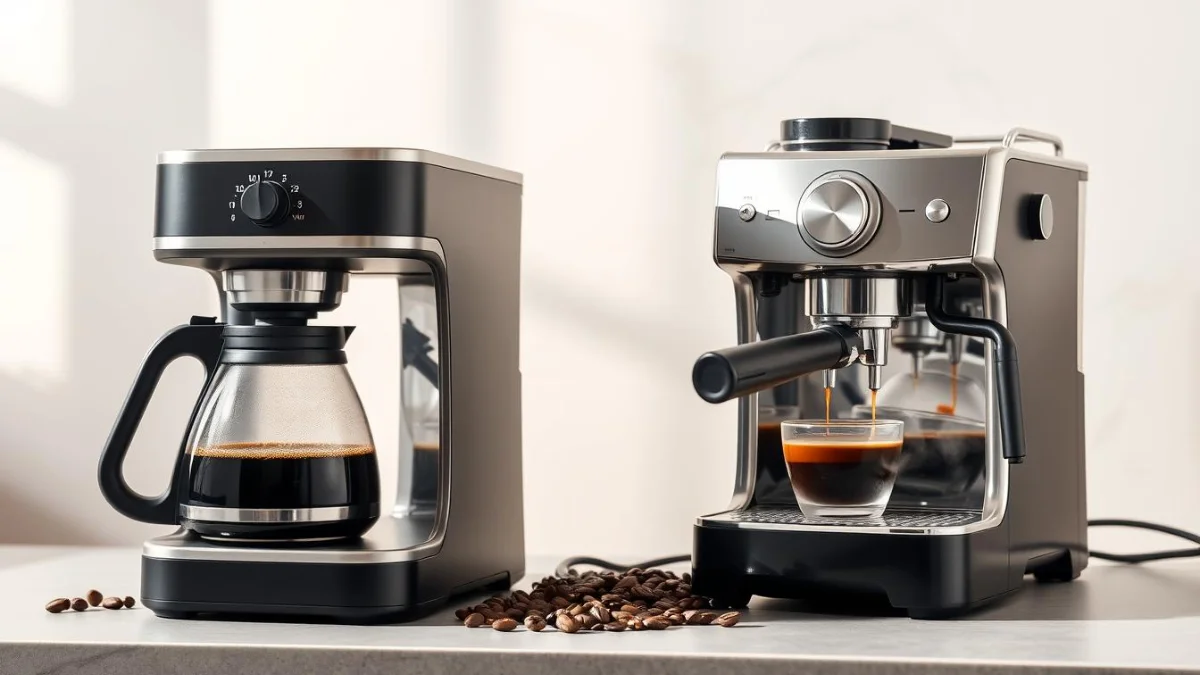
Choosing between a coffee maker vs espresso machine can be a challenging decision for coffee enthusiasts. Both appliances promise to deliver that perfect cup of morning brew, but they differ significantly in brewing methods, flavor profiles, and price points.
Whether you’re craving a smooth, mellow cup of drip coffee or a rich, concentrated espresso shot, understanding the key differences will help you make an informed decision that matches your coffee preferences, budget, and lifestyle.
What is an Espresso Machine?
An espresso machine is a specialized coffee brewing device designed to produce concentrated shots of coffee by forcing pressurized hot water through finely-ground coffee beans. The result is a small, intense serving of coffee with a layer of crema (a golden foam) on top. Espresso serves as the foundation for various coffee drinks, including lattes, cappuccinos, macchiatos, and Americanos.

How Espresso Machines Work
Espresso machines operate on a simple principle: using pressure to extract maximum flavor in minimum time. The brewing process involves several key steps:
- Water is heated to an optimal temperature (195-205°F or 90-96°C)
- The machine forces this hot water through finely ground, compacted coffee at high pressure (9-15 bars)
- The pressurized extraction process pulls oils, flavors, and compounds from the coffee in 20-30 seconds
- The result is a concentrated shot with a rich crema layer on top
This high-pressure brewing method creates a distinct flavor profile that’s more intense than coffee from a drip machine. The pressure extracts compounds that aren’t released during gravity-based brewing, resulting in a more complex flavor profile and thicker body.
Different Types of Espresso Machines

Manual Espresso Machines
These machines give you complete control over the brewing process. You’ll manually control water flow, pressure, and extraction time. They require skill and practice but offer the most customization for espresso enthusiasts.
Semi-Automatic Machines
The most popular type for home use, semi-automatic machines handle water pressure and temperature while you control the grinding, tamping, and extraction timing. They balance control with convenience.
Super-Automatic Machines
These all-in-one machines handle everything from grinding beans to extracting espresso at the push of a button. They’re convenient but offer less control over the brewing variables.
What is Coffee Maker Style Coffee?
Coffee maker style coffee, commonly known as drip coffee, is brewed by passing hot water through medium-ground coffee beans in a filter. The water absorbs the coffee’s flavors and oils as it drips through the grounds and into a carafe below. This method produces a milder, less concentrated beverage that’s typically served in larger portions than espresso.
How Coffee Makers Work

Drip coffee makers use a straightforward brewing process that relies on gravity rather than pressure:
- Cold water is added to a reservoir and heated to the optimal brewing temperature
- The heated water travels up a tube and is dispersed over the coffee grounds in a filter basket
- Water flows through the grounds by gravity, extracting flavors and oils
- The brewed coffee drips into a carafe or pot below
- The entire process typically takes 5-10 minutes for a full pot
This gentle extraction method produces coffee with less acidity and bitterness than espresso. The paper filters used in most drip machines also remove many of the oils present in coffee, resulting in a cleaner, lighter-bodied cup compared to other brewing methods.
The Difference Between a Coffee Maker and an Espresso Machine
Understanding the key differences between these brewing methods will help you determine which machine better suits your coffee preferences and lifestyle needs.
| Feature | Coffee Maker | Espresso Machine |
| Brewing Method | Gravity-driven drip method | Pressure-driven extraction (9-15 bars) |
| Brewing Time | 5-10 minutes for a full pot | 20-30 seconds per shot |
| Grind Size | Medium grind | Fine grind |
| Flavor Profile | Milder, less concentrated | Rich, intense, concentrated |
| Serving Size | Multiple cups (4-12) | Single or double shots |
| Drink Versatility | Primarily black coffee | Espresso, lattes, cappuccinos, etc. |
| Price Range | $25-$350 | $100-$1,500+ |
| Skill Required | Minimal | Moderate to high |
| Maintenance | Simple, occasional descaling | More complex, regular cleaning |

Should You Get an Espresso Machine or a Coffee Maker?
Choosing between these two brewing systems depends on several factors, including your coffee preferences, budget, time commitment, and desired level of involvement in the brewing process.
When to Choose a Coffee Maker
- You prefer larger quantities of milder coffee
- You’re on a tighter budget
- You want a simple, low-maintenance brewing process
- You need to serve multiple people regularly
- You prefer a set-it-and-forget-it approach to brewing
When to Choose an Espresso Machine
- You enjoy concentrated, intense coffee flavors
- You prefer specialty drinks like lattes and cappuccinos
- You’re willing to invest more money up front
- You enjoy the craft and process of making coffee
- You want more control over brewing variables

Best Selling Coffee Makers & Espresso Machines
If you’ve decided a coffee maker is the right choice for your needs, here are two excellent options that offer great value and performance.
BLACK+DECKER 12-Cup Digital Coffee Maker
This programmable coffee maker offers convenience and reliability at an affordable price point. With features like a programmable timer and Sneak-A-Cup technology, it’s perfect for busy households.
Core Features
- 2-hour auto shutoff for safety
- 12-cup capacity glass carafe
- Programmable 24-hour auto brew function
- ‘Sneak-A-Cup’ feature allows you to pour a cup mid-brew
- Washable and reusable filter basket
Key Specifications
| 12 cups | 8.25 x 12.25 x 11 inches |
| Weight: 4.75 pounds | Height: 11inches |
| Glass Carafe | 2-year limited Warranty |
Striking Point
The Sneak-A-Cup feature temporarily stops the flow of coffee so you can pour your first cup before brewing ends – perfect for those who can’t wait for the whole pot to finish.

Pros
- Reusable filter saves money long-term
- Affordable price point
- Easy programming for auto-brew
- Compact design fits most countertops
Cons
- No temperature control options
- Plastic components may not be as durable
- Basic feature set compared to premium models
Ninja 12-Cup Programmable Coffee Brewer
The Breville Barista Express is a semi-automatic espresso machine that combines precision, versatility, and convenience. With its built-in grinder and pressure gauge, it offers barista-quality espresso at home.
Core Features
- 12-cup glass carafe with precision temperature warming plate
- Two brew styles: Classic and Rich
- Programmable 24-hour delay brew
- 60oz removable water reservoir for easy filling
- Mid-brew pause function
Key Specifications
| 12 cups | 8″D x 10″W x 14″H inches |
| Weight: 6.55 Pounds | Height: 14 inches |
| Glass Carafe | 1-year limited Warranty |
Striking Point
The adjustable warming plate keeps coffee at the ideal temperature without burning it, maintaining fresh flavor for up to 4 hours before automatic shutoff.

Pros
- Multiple brew strength options
- Large, removable water reservoir
- Adjustable warming plate temperature
- Sleek, modern design
Cons
- Higher price point than basic models
- Larger footprint requires more counter space
- Some users report noise during brewin
Breville Barista Express Espresso Machine
The Breville Barista Express is a semi-automatic espresso machine that combines precision, versatility, and convenience. With its built-in grinder and pressure gauge, it offers barista-quality espresso at home.
Core Features
- Integrated conical burr grinder with dose control
- Digital temperature control (PID) for optimal extraction
- 15-bar Italian pump with pressure gauge
- Steam wand for manual microfoam milk texturing
- 54mm portafilter with commercial-style spouts
Key Specifications
| 67 oz (2L) | 12.5 x 12.6 x 13.1 inches |
| Weight:23 pounds | Height: 15.9 inches |
| 1600W | 1-year limited Warranty |
Striking Point
The built-in conical burr grinder delivers the perfect amount of freshly ground coffee directly into the portafilter, eliminating the need for a separate grinder and ensuring maximum freshness.

Pros
- All-in-one solution with built-in grinder
- Precise temperature control for optimal extraction
- Pressure gauge helps perfect your technique
- Durable stainless steel construction
Cons
- Significant learning curve for beginners
- Higher price point
- Takes up considerable counter space
- Single boiler means waiting between brewing and steaming
CASABREWS CM5418 Espresso Machine
The CASABREWS CM5418 offers an affordable entry point into the world of espresso. With its 20-bar pressure system and milk frother, it delivers quality espresso drinks without breaking the bank.
Core Features
- 20 bar pressure pump system
- Steam milk frother for cappuccinos and lattes
- 34oz removable water tank
- Stainless steel construction
- Compatible with both ground coffee and ESE pods
Key Specifications
| Capacity: 14 ounces | 16.9″D x 5.5″W x 12.4″H |
| Weight: 8.59 Pounds | Height: 11.97 Inches |
| 1260 watts | 1-year limited Warranty |
Striking Point
The Centrifusion technology spins the pod up to 7,000 rotations per minute, blending ground coffee with water to create the perfect crema for both espresso and coffee varieties.
Pros
- Budget-friendly price point
- Compact design fits smaller kitchens
- Easy to use for beginners
- Versatile with ground coffee and ESE pod compatibility
Cons
- Smaller water tank requires frequent refilling
- Less precise temperature control
- Steam wand has limited articulation
- Plastic components may affect longevity
Nespresso Vertuo Next Coffee and Espresso Maker
The Nespresso Vertuo Next offers ultimate convenience with its pod-based brewing system. It can make both espresso and regular coffee with the touch of a button, making it perfect for those who value simplicity and versatility.
Core Features
- Centrifusion technology reads pod barcodes for optimal brewing
- Makes 5 cup sizes: espresso (1.35 oz), double espresso (2.7 oz), gran lungo (5 oz), coffee (8 oz), and alto (14 oz)
- Fast heat-up time of 30 seconds
- 37 oz removable water tank
- Energy-saving automatic shutoff after 9 minutes
Key Specifications
| 12 cups | 8.25 x 12.25 x 11 inches |
| Weight: 4.75 pounds | Height: 12.4 inches |
| Glass Carafe | 2-year limited Warranty |
Striking Point
The Sneak-A-Cup feature temporarily stops the flow of coffee so you can pour your first cup before brewing ends – perfect for those who can’t wait for the whole pot to finish.
Pros
- Reusable filter saves money long-term
- Affordable price point
- Easy programming for auto-brew
- Compact design fits most countertops
Cons
- No temperature control options
- Plastic components may not be as durable
- Basic feature set compared to premium models
Comparison Table: Coffee Maker vs Espresso Machine
This side-by-side comparison highlights the key differences between coffee makers and espresso machines to help you make your final decision.
| Feature | Coffee Maker | Espresso Machine |
| Brewing Method | Gravity-driven drip method | Pressure-driven extraction |
| Pressure | None (gravity only) | 9-15 bars |
| Brew Time | 5-10 minutes | 20-30 seconds |
| Coffee Strength | Milder, less concentrated | Strong, concentrated |
| Price Range | $25-$350 | $100-$1,500+ |
| Skill Level | Beginner | Beginner to Advanced |
| Versatility | Limited to drip coffee | Multiple drink types possible |

Final Verdict
When choosing between a coffee maker vs espresso machine, there’s no one-size-fits-all answer. Your decision should be based on your coffee preferences, budget, and lifestyle.
Choose a Coffee Maker If:
- You prefer larger quantities of milder coffee
- You’re on a budget and want an affordable option
- You value simplicity and convenience
- You need to serve multiple people regularly
- You don’t need specialty drinks like lattes
Choose an Espresso Machine If:
- You enjoy concentrated, intense coffee flavors
- You want to make specialty drinks like lattes and cappuccinos
- You’re willing to invest more money up front
- You enjoy the craft and process of making coffee
- You want more control over brewing variables
Consider Both If:
- You prefer larger quantities of milder coffee
- You’re on a budget and want an affordable option
- You value simplicity and convenience
- You need to serve multiple people regularly
- You don’t need specialty drinks like lattes

For most casual coffee drinkers who prioritize convenience and affordability, a quality drip coffee maker like the Ninja 12-Cup Programmable Coffee Brewer is an excellent choice. For those who appreciate the art of espresso and enjoy specialty coffee drinks, the Breville Barista Express offers the best balance of quality and features. If simplicity is your priority but you still want espresso options, the Nespresso Vertuo Next provides an excellent middle ground.
Ready to upgrade your coffee experience?
Choose the brewing system that matches your preferences and enjoy café-quality coffee at home.
Frequently Asked Questions
Can an espresso machine make regular coffee?
Traditional espresso machines aren’t designed to make regular drip coffee. However, you can make an Americano (espresso with added hot water) that’s similar to drip coffee. Some super-automatic and pod-based machines like the Nespresso Vertuo line are specifically designed to make both espresso and regular coffee.
How much should I expect to spend on a good coffee maker or espresso machine?
For coffee makers, quality options range from $30 to $350, with most good programmable models falling between $50-$150. Espresso machines have a wider price range, starting around $100 for basic models and reaching $1,500+ for prosumer-grade equipment. A good entry-level espresso machine with essential features typically costs between $200-$500.
Which is more cost-effective in the long run?
While coffee makers have a lower initial cost, the long-term economics depend on your coffee habits. If you regularly buy specialty coffee drinks from cafés, an espresso machine can pay for itself within months. For casual coffee drinkers, a drip coffee maker is more economical. Pod-based systems like Nespresso have ongoing costs for proprietary capsules that make them more expensive over time compared to machines that use ground coffee.
How much maintenance do coffee makers and espresso machines require?
Coffee makers require minimal maintenance—regular cleaning and occasional descaling to remove mineral buildup. Espresso machines need more attention, including daily cleaning of the portafilter and steam wand, regular backflushing, and periodic descaling. Semi-automatic and manual espresso machines have more parts that may need maintenance or replacement over time.
Which is better for beginners?
Drip coffee makers are more beginner-friendly due to their simple operation and forgiving nature. For those interested in espresso, pod-based systems like Nespresso offer the easiest entry point, while semi-automatic machines like the CASABREWS CM5418 provide a good balance of accessibility and authentic espresso experience. Manual espresso machines have the steepest learning curve but offer the most control for enthusiasts.